You refreshed the screen for the third time in an hour.
The job is basically yours — the interviews went great, the recruiter all but handed you the offer, and the only thing standing between you and your start date is the background check. You log into the screening portal, heart thumping, and there it is. A single word next to your name.
Decisional.
Not “eligible.” Not “clear.” Not “pass.” Just… decisional. And your brain immediately fills in the worst-case scenario. Did something show up? Did they find that old thing? Is the offer about to evaporate?
Take a breath. Because here’s what almost nobody tells you in that panicked moment: a decisional status is not a rejection. It’s not a denial. It’s not even necessarily bad news. It’s a routing label — a sign that a human being at the company needs to take a closer look before the final call gets made.
So let’s clear up the confusion once and for all. What does decisional mean on a background check, why did you get flagged with it, and what should you actually do next?
This guide breaks it all down.
What Does Decisional Mean on a Background Check? The Plain-English Answer
Let’s start with the definition that actually makes sense.
A “decisional” status means your background check report contains something that requires a human at the hiring company to review it before they make a final decision. That’s it. The automated screening system couldn’t auto-approve you, so it kicked your report over to a person.
Here’s the key distinction that puts most applicants at ease. Background check reports run through screening companies typically come back with one of two overall statuses: “eligible” or “decisional.” An eligible status means your report cleanly met the employer’s pre-set hiring criteria — no review needed. A decisional status means there’s something the employer’s team needs to look at manually before deciding.
According to background screening giant First Advantage, “decisional” simply means the company has configured its background check to require additional review by them — and the screening company itself has nothing to do with the criteria used to make that decision. In other words, the screening provider isn’t judging you. They’re just flagging the report and handing it to the employer.
Think of it like airport security. Most travelers walk straight through the scanner — that’s “eligible.” But sometimes the machine beeps and an agent pulls you aside for a closer look. That second screening isn’t an accusation. It’s a procedure. Most people who get the extra check walk through to their gate just fine.
A decisional status is that second look. Here’s why it happens.
Why Your Background Check Came Back Decisional
Now here’s the part that actually matters to you.
A decisional result gets triggered when something on your report doesn’t cleanly match the employer’s automatic “approve” criteria. But “doesn’t cleanly match” covers a huge range of situations — many of which have nothing to do with you being a bad candidate.
Criminal Record Flags
The most common trigger is a criminal record entry. If your report shows a conviction, a pending charge, or even an old arrest, the screening system often can’t decide on its own whether it disqualifies you for the specific role — so it flags the report for human review.
Importantly, this includes minor stuff. A years-old misdemeanor, a dismissed charge, or a single low-level offense can all trigger a decisional status even when they’re nowhere near serious enough to cost you the job. For a deeper look at how these records appear, see ClearCheck’s what shows up on a background check guide.
Data Discrepancies and Incomplete Information
Here’s a cause that surprises people: sometimes a decisional status has nothing to do with criminal history at all. It can be triggered by a minor inconsistency between your application and the investigative findings, or because some piece of information was incomplete or couldn’t be immediately verified.
A mismatched employment date. A name variation. A county court that was slow to return records. Any of these can route your report to manual review.
Missing Dispositions on Old Charges
One frustrating trigger: a charge that shows up without its final outcome. If a dismissed case appears on your report but the “dismissed” disposition is missing, the system sees an open-looking charge and flags it. This is exactly the kind of error you can fix — more on that shortly. ClearCheck’s guide on whether dismissed charges show up on a background check explains your right to correct incomplete records like these.
Industry and Role Sensitivity
The threshold for a decisional flag varies wildly by industry. Highly regulated fields — childcare, healthcare, finance, anything serving vulnerable populations — set far stricter matrices, which means far more reports get routed to review. A record that sails through as “eligible” for a warehouse role might come back “decisional” for a hospital position.
Eligible vs. Decisional: Understanding the Adjudication Matrix
To really understand what decisional means on a background check, you need to understand the machine behind the label.
That machine is called an adjudication matrix — and it’s the engine that decides whether you come back “eligible” or “decisional.”
What Is an Adjudication Matrix?
An adjudication matrix (sometimes called a hiring or decision matrix) is essentially a pre-set rulebook. It’s a table or form listing specific criminal offenses and how each one should be handled for a given role. Many organizations use an automated screening matrix to efficiently determine whether a candidate is eligible for hire based on the results of their background check.
Here’s how it works in practice. The screening company runs your criminal searches, verifications, and other components. The matrix digitally analyzes those results against the employer’s pre-set guidelines. Then it returns one of two outcomes: “eligible” for hire, or “decisional” — meaning a human needs to weigh in.
How Adjudication Actually Works
Adjudication is the process of evaluating your background check results against the company’s specific hiring policy. The automated matrix handles the first pass. But for anything that falls into a gray area, the employer’s hiring team takes over.
That team reviews your application materials, the background report, and all available relevant information, then decides whether to advance you to the hiring manager — or not. The decisional status is simply the handoff point between the machine and the human.
Why Smart Employers Are Cautious With Matrices
Here’s something most applicants never learn: many employment attorneys actually caution employers against relying too heavily on rigid adjudication matrices, because a poorly designed one can put them in the crosshairs of the EEOC.
Why? Because automatically excluding everyone with any record can create illegal discrimination. That’s why the “decisional” routing exists in the first place — it forces a human, individualized look rather than a blanket auto-reject. For the framework employers should follow when evaluating any flagged record, see ClearCheck’s felony background check guide.
Is Decisional Bad on a Background Check?
Let’s tackle the question you’re really asking.
No — a decisional status is not inherently bad. It is genuinely neutral. It means “needs a human look,” not “rejected.” Plenty of decisional reviews end with the candidate getting hired.
But let’s be honest and balanced about it.
A decisional status does mean something on your report caught the matrix’s attention. It might be trivial — a data mismatch, a slow court record, an ancient misdemeanor that won’t matter. Or it might be more serious — a recent conviction directly relevant to the role. The status itself doesn’t tell you which. It just tells you a person is now reviewing.
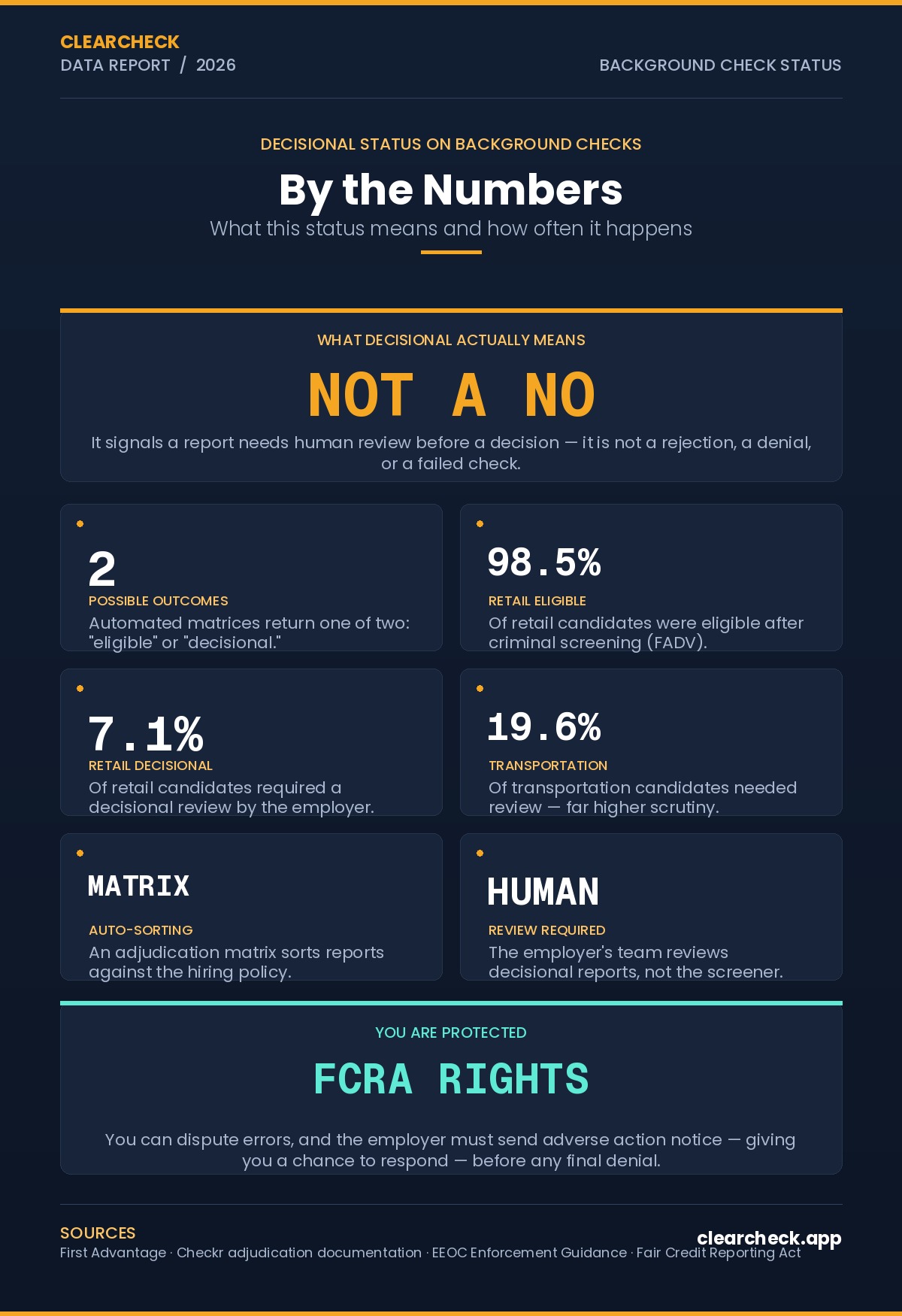
Here’s the reassuring data point: decisional reviews are common, and most candidates still pass. Industry benchmarking from First Advantage found that in retail, about 98.5% of candidates were eligible for hire after criminal screening, while roughly 7.1% required a decisional review. In transportation, about 96.9% were eligible, with 19.6% requiring a decisional review. Even in the higher-review industries, the vast majority of people who get flagged for review are still cleared.
So if you see “decisional,” the honest takeaway is: don’t panic, but do pay attention. It’s a checkpoint, not a verdict.

What to Do If Your Background Check Is Decisional
Here’s your action plan — the part that turns anxiety into a plan.
Step 1: Run a Background Check on Yourself
This is the single most valuable move. Run your own background check using employer-grade data sources so you can see exactly what the employer is reviewing. You can’t fix what you can’t see — and a self-check reveals whether the trigger was a real record or a fixable error.
Step 2: Request the Company’s Hiring Policy
A decisional status relates to your history and the company’s specific policy. You have every right to ask the employer about their criteria. Understanding what the matrix flagged — and why — tells you whether you’re dealing with a quick clarification or a genuine concern.
Step 3: Be Ready to Explain or Provide Context
If the flag is a real record, prepare to discuss it honestly and provide context. Many decisional reviews come down to the hiring team wanting to understand the circumstances, the time elapsed, and your rehabilitation. The EEOC actually requires employers to consider exactly these factors, so your explanation matters.
Step 4: Dispute Inaccurate or Incomplete Information
If the decisional status was triggered by an error — a dismissed charge missing its disposition, a record that isn’t yours, or outdated information — you have the right under the Fair Credit Reporting Act to dispute it. The screening agency must reinvestigate, typically within 30 days, and correct or remove inaccurate information. For more on lookback windows and what can legally be reported, see ClearCheck’s how far back a background check goes guide.
Step 5: Know Your Adverse Action Rights
If the employer ultimately decides not to hire you based on the report, they must follow the FCRA adverse action process: a pre-adverse action notice with a copy of the report, reasonable time for you to respond, and then a final adverse action notice. This is your window to dispute or explain before anything becomes final.
What the Research Says About Records, Reviews, and Fair Hiring
Here’s a finding from the academic literature that reframes why decisional reviews exist — and why they matter for fairness.
A widely cited study by economists Amanda Agan (Rutgers) and Sonja Starr (University of Michigan), Ban the Box, Criminal Records, and Statistical Discrimination, hosted by Yale Law School, examined what happens when employers can and cannot see criminal history early in the hiring process. Their large-scale field experiment sent out nearly 15,000 fake job applications to test employer behavior.
The finding that matters here: when employers couldn’t individually assess criminal records, many fell back on crude assumptions — and that increased racial discrimination, because employers guessed about who might have a record rather than evaluating actual information.
What does this tell us about decisional reviews?
It tells us that the individualized, human review a decisional status triggers is exactly what fair hiring is supposed to look like. The alternative — a blanket auto-reject of anyone with any flag — isn’t just bad for candidates; the research shows it produces worse, more discriminatory outcomes. A decisional review, done right, is the system working as intended: a real person looking at real information, considering the nature of the record, the time elapsed, and the relevance to the job.
That’s the EEOC’s individualized-assessment standard in action. And it’s why the “decisional” label, frustrating as it feels in the moment, is actually a protection.
Visual Data Report: Decisional Background Check Status in 2026
Here is a snapshot of what decisional status means and how often it happens.
What Employers Should Know About Decisional Status
Here’s the other side of the screen — because employers get this wrong constantly.
A decisional status is a compliance tool, not a rejection button. How you handle it determines whether you’re protected or exposed.
Decisional Means Review, Not Reject
The whole point of a decisional outcome is to force an individualized assessment. Treating every decisional flag as an automatic disqualification defeats the purpose and recreates exactly the blanket-exclusion liability the EEOC warns against. A decisional report should land on a human’s desk for genuine evaluation — not get rubber-stamped into a rejection.
Apply the EEOC’s Three Factors
When reviewing a decisional report, the EEOC expects employers to weigh three things: the nature and gravity of the offense, the time that has elapsed since it occurred, and the relevance of the offense to the specific job. A decade-old misdemeanor unrelated to the role is very different from a recent, directly relevant conviction.
Document Everything and Follow Adverse Action
If a decisional review leads to a decision not to hire, the FCRA adverse action process is mandatory: pre-adverse notice with a copy of the report, a reasonable waiting period, and a final notice. Document the individualized assessment too — it’s your best defense against a discrimination claim. The foundation of all of this is an accurate report; for a comparison of reliable screening sources, see the best criminal background check sites for employers in 2026.
Frequently Asked Questions About Decisional Background Checks
What does decisional mean on a background check?
It means your report contains something that requires the hiring company to review it manually before making a final decision. It’s a routing status — not a rejection. The automated screening matrix couldn’t auto-approve your report, so it flagged it for human review.
Is decisional bad on a background check?
No, decisional is neutral, not bad. It means “needs review,” not “denied.” Many candidates with a decisional status are ultimately hired. It simply signals that a person needs to look at your report before the final call, which can happen for reasons ranging from a minor data mismatch to a criminal record entry.
What’s the difference between eligible and decisional?
“Eligible” means your report cleanly met the employer’s automatic hiring criteria — no review needed. “Decisional” means something didn’t auto-clear and a human must review it before deciding. Both are routing statuses assigned by an adjudication matrix; only “decisional” requires manual employer review.
How long does a decisional review take?
It varies by employer, since the review is done by their internal hiring team rather than the screening company. It can take anywhere from a day to a couple of weeks, depending on how quickly the team reviews flagged reports and whether they need additional information from you.
Does decisional mean I failed the background check?
No. There is no automatic “fail” in a decisional status. It means the decision is pending human review. You only have an adverse outcome if the employer reviews the report and decides not to proceed — and even then, they must give you adverse action notice and a chance to respond first.
Can I do anything to move a decisional status forward?
Yes. Run a background check on yourself to see what’s flagged, ask the employer about their hiring criteria, be ready to provide context for any record, and dispute any inaccurate or incomplete information with the screening agency under your FCRA rights.
Why did I get a decisional status with a clean record?
A decisional status doesn’t always mean a criminal record. It’s frequently triggered by data discrepancies — a mismatched employment date, a name variation, a slow-reporting court, or incomplete information that couldn’t be auto-verified. These are often quick to clarify or dispute.
The Bottom Line on Decisional Background Check Status
Here’s the honest summary.
What does decisional mean on a background check? It means your report needs a human at the hiring company to review it before the final decision — nothing more, nothing less. It is not a rejection, it is not a failure, and it is frequently not even bad news. It’s a checkpoint built into the system precisely to ensure a fair, individualized look rather than a blanket auto-reject.
If you see “decisional,” don’t spiral. Run a check on yourself to see what’s flagged, understand whether it’s a real record or a fixable error, and be ready to provide context or dispute inaccuracies. The data shows most flagged candidates still get hired.
And if you’re an employer, remember: a decisional status is a compliance feature, not a reject button. Handle it with a genuine individualized assessment, follow the FCRA, and document your reasoning.
Either way, the foundation is the same: an accurate, current, fully verified background check. That’s what ClearCheck delivers — fast, FCRA-compliant reports built on authoritative records, so the picture you’re reviewing is the real one.
See Exactly What Your Background Check Shows — Starting at $19.99
A “decisional” status is the worst time to be guessing about what’s on your report.
Whether you’re an applicant who just got flagged and needs to know what triggered it, or an employer who needs accurate data to make a defensible decisional review, you need the real picture now. ClearCheck delivers fast, FCRA-compliant background checks built on current, authoritative court records — in 30 seconds, starting at $19.99 per check. No contracts. No setup fees.
Stop refreshing the status screen and start getting answers. Run your check today and walk into that review knowing exactly where you stand.
Limited-time launch pricing on all four tier packages. Set up your account and run your first check in under five minutes.