You just nailed the interview. The hiring manager smiled, shook your hand, and said the words you’ve been waiting for: “We’d like to move forward.”
Then came the next sentence: “We’ll just need to run a background check.”
And suddenly your stomach drops.
Not because you’ve done anything terrible. But because you don’t know exactly what they’re going to find. That speeding ticket from college. The apartment you got evicted from during COVID. The gap on your resume where you were between jobs for six months. That old arrest that was dismissed.
What shows up on a background check? What doesn’t? And is there anything you can do about it before the results come back?
You’re not alone in asking. According to PBSA and HR.com, 94% of employers run some form of background screening before making a hire. That means almost every job offer you’ll ever receive will be contingent on this step. And yet most candidates go into it blind — anxious about the wrong things, unaware of their rights, and unprepared for what the report actually contains.
This guide is written for you — the candidate. Not the employer, not the HR team, not the screening provider. You. Here’s exactly what shows up, what doesn’t, and what you can do about it.
What Shows Up on a Background Check: The Complete List
The specific items that appear on your report depend on the screening package your employer ordered. Not every employer checks the same things. But here’s the full universe of what can show up.
Criminal Records
This is what most candidates worry about — and it’s the most commonly searched component.
What shows up: felony convictions, misdemeanor convictions, pending criminal charges, active warrants, and sex offender registry status. In some states, arrest records may also appear even if the charges were dismissed or you were acquitted.
What doesn’t show up: sealed or expunged records (if the court has ordered your record sealed, a compliant screening provider will not report it), juvenile records (sealed in most jurisdictions), and records beyond the applicable lookback period (typically seven years for non-convictions under the FCRA, though convictions can be reported indefinitely in many states).
Here’s what matters most: having a criminal record does not automatically disqualify you. The EEOC requires employers to conduct an individualized assessment — weighing the nature of the offense, how long ago it occurred, and whether it’s relevant to the job. Many employers hire people with records every single day.
For a deep dive into lookback limits, see ClearCheck’s guide on how far back a background check goes.
Employment History
Your employer will likely verify some or all of the jobs you listed on your resume. The screening provider contacts former employers to confirm job titles, dates of employment, and sometimes salary and reason for departure.
What shows up: confirmed employment dates, job titles, and whether the information matches what you reported. If there are discrepancies — you said you worked somewhere for three years but the employer confirms two — that gap becomes visible.
What catches people off guard: employment gaps. The background check doesn’t just show where you worked — it reveals where you didn’t. If you listed “2020–2023” on your resume but the employer confirms “2020–2022,” the unexplained year becomes a question mark.
Pro tip: Don’t fabricate or stretch employment dates. The verification will catch it. Instead, be prepared to explain gaps honestly during the interview — employers understand that life happens.
Education Credentials
Education verification confirms the degrees, certifications, and attendance dates you claimed on your application.
What shows up: the institution you attended, dates of attendance, degree earned, and field of study. If you claimed a degree you didn’t finish, the report will show the discrepancy.
Research from the Georgetown University Center on Education and the Workforce has documented that credential misrepresentation remains common across industries. The Des Moines superintendent hired in 2025 despite an unfinished doctorate is a high-profile example — but similar issues surface at every level.
Credit Report
Not every employer pulls your credit. This is primarily for roles involving financial responsibility — banking, accounting, executive positions, or any role with access to company funds.
What shows up: outstanding debts, accounts in collections, bankruptcies, tax liens, and payment history. Importantly, employers see a modified credit report — they do not see your actual credit score.
What doesn’t show up: your credit score number, specific account numbers, or your entire financial history. And several states now restrict or prohibit credit checks for employment unless the role directly involves financial duties.
Driving Record
If the job involves driving, the employer will pull your motor vehicle record.
What shows up: traffic violations, DUI/DWI convictions, license suspensions or revocations, accident history, and license class.
If driving isn’t part of the job, this check won’t be ordered — and your driving history won’t appear on the report.
Drug Test Results
Drug screening is common in healthcare, manufacturing, transportation, childcare, and government roles. If your employer includes it, the results will appear as part of your screening.
What shows up: positive or negative results for controlled substances. If you have a valid prescription that explains a positive result, the Medical Review Officer (MRO) will contact you for documentation before finalizing the report.
Social Media
A growing number of employers now include social media screening — but it’s more limited than most people fear.
What shows up: publicly available posts flagged for threats, violence, harassment, hate speech, or evidence of illegal activity. Responsible screening providers use AI to scan public profiles and filter out protected class information.
What doesn’t show up: private accounts, direct messages, content behind privacy settings, and anything related to your race, religion, political views, disability, or other protected characteristics. Employers cannot see your private Instagram stories, your locked Twitter account, or your anonymous Reddit posts.
Pro tip: Review your public social media profiles before a job search. Remove or restrict anything that could be misinterpreted. You don’t need to delete your personality — just make sure your public-facing content reflects the image you want employers to see.
What Does NOT Show Up on a Background Check
This is where most candidate anxiety comes from — worrying about things that will never appear on the report. Here’s what is explicitly excluded from every FCRA-compliant screening:
Medical records. Completely off-limits. Protected by HIPAA. No employer can see your diagnoses, treatments, prescriptions, or therapy history.
Mental health history. Same as medical records — fully protected.
Sealed or expunged records. If a court has ordered your record sealed or expunged, it should not appear on a compliant screening report. In 2026, Clean Slate laws in Virginia, Pennsylvania, D.C., and other states are automatically sealing more records than ever.
Genetic information. Protected under the Genetic Information Nondiscrimination Act (GINA).
Workers’ compensation claims. Cannot be used in pre-employment decisions.
Internet search and browsing history. Your employer cannot see what websites you’ve visited, what you’ve Googled, or what you’ve watched online.
Private social media content. Only publicly available information can be reviewed — and responsible providers filter out protected characteristics.
Juvenile records. Sealed in most jurisdictions and not reportable on standard background checks.
Salary history. An increasing number of states prohibit employers from asking about or using your salary history in hiring decisions.
Records from other countries. Unless the employer specifically orders an international background check, your history from outside the United States won’t appear.
For the full breakdown from the employer’s perspective, see ClearCheck’s companion guide on what a background check consists of.

Five Things That Surprise Candidates the Most
Even candidates with clean records get caught off guard. Here are the five most common surprises.
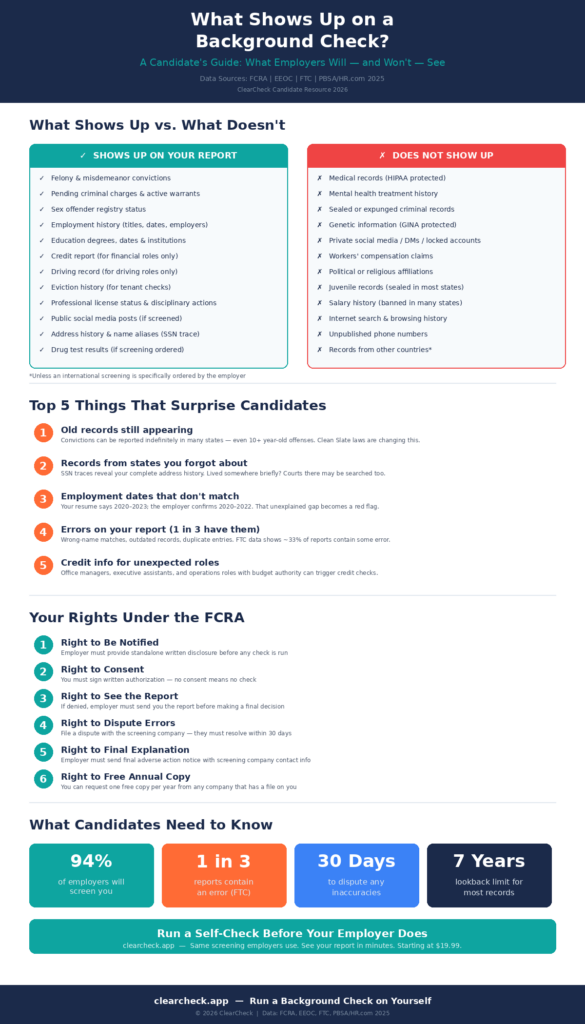
- Old records still appearing. In states without conviction lookback limits, a felony from 15 years ago can still show up on your report. Even if you’ve turned your life around completely, the record is technically reportable. The good news: Clean Slate laws are changing this in more states every year.
- Records from states you forgot about. The SSN trace at the beginning of every background check reveals your complete address history. Lived in another state for six months during college? The screening provider may search court records there too. That minor charge you forgot about from a different state can resurface.
- Employment dates that don’t match your resume. You said you worked at a company from “January 2019 to March 2022.” The employer’s records say “March 2019 to December 2021.” That three-month discrepancy — which might just be a rounding error in your memory — becomes a red flag on the report.
- Errors on your report. The FTC has documented that approximately one in three consumer reports contain some form of error. Common issues include records belonging to someone with a similar name being attached to your report, outdated records that should have been sealed, and duplicate entries for the same offense. You have the right to dispute these — and the screening provider must investigate within 30 days.
- Credit information for roles you didn’t expect. Some job titles that don’t sound “financial” still involve enough monetary responsibility to trigger a credit check — office managers who handle petty cash, executive assistants who manage expense accounts, or operations roles with procurement authority.
Your Rights Under the FCRA: What Every Candidate Must Know
The Fair Credit Reporting Act (15 U.S.C. § 1681) gives you specific, enforceable rights throughout the background check process. Know them.
Right to be notified. Your employer must provide a standalone written disclosure that a background check will be conducted — before it happens. This cannot be buried in the job application.
Right to consent. You must sign a written authorization before any search begins. No consent, no check.
Right to see the report. If the employer decides not to hire you based on the screening results, they must send you a copy of the report before making the final decision (this is the pre-adverse action notice).
Right to dispute. If you find an error in the report, you can dispute it directly with the screening company. They must investigate and resolve the dispute within 30 days.
Right to a final explanation. If the employer proceeds with the adverse decision after the dispute period, they must send a final notice that includes the screening company’s contact information and your right to a free copy of the report within 60 days.
Right to a free annual report. You’re entitled to one free copy of your screening report per year from any company that has a file on you.
These aren’t suggestions — they’re federal law. If an employer skips any of these steps, they’ve violated the FCRA, and you may have grounds for legal action.
How to Prepare Before Your Background Check
You don’t have to wait for the results and hope for the best. Here’s how to take control.
Run a check on yourself first. This is the single best thing you can do. ClearCheck lets you run a background check on yourself using the same FCRA-compliant process employers use. You’ll see exactly what they’ll see — and you’ll have time to address any issues before they become surprises.
Verify your own employment dates. Before listing dates on your resume, confirm them. Contact former employers or check old tax returns and W-2 forms for exact dates. A small discrepancy in your memory can create a large question mark on the report.
Review your credit report. You’re entitled to a free annual credit report from each of the three major bureaus at annualcreditreport.com. Check for errors, outdated accounts, and items that should have been removed.
Check your social media. Google yourself. Look at your public profiles on every platform. Remove or restrict anything you wouldn’t want a hiring manager to see. This takes ten minutes and can prevent a headache.
Prepare to address findings honestly. If you know something will appear — a past conviction, a credit issue, an employment gap — prepare a brief, honest explanation. Proactive transparency builds trust. Hiding it and hoping it doesn’t come up is almost always the worse strategy.
Dispute errors immediately. If your self-check reveals something inaccurate — a record that’s been expunged but still appears, a record belonging to someone else, or an incorrect employment date — file a dispute before your job search begins.
For a full understanding of how much a self-check costs, ClearCheck offers transparent pricing with no subscriptions.

The Bottom Line: Knowledge Is Your Best Advantage
What shows up on a background check? Criminal records, employment history, education credentials, and — depending on the role — credit reports, driving records, and drug tests. What doesn’t show up? Medical records, sealed records, private social media, browsing history, and a long list of protected information.
The candidates who handle background checks best aren’t the ones with perfect records. They’re the ones who know what to expect, check their own report first, and address issues proactively instead of hoping they disappear.
Run a self-check. Know your rights. Prepare for findings honestly. And walk into your next background check with confidence instead of anxiety.
See What Employers See — Before They See It
Don’t wait for a background check to surprise you. Surprise it first. ClearCheck lets you run the same FCRA-compliant screening employers use — on yourself. See your complete report in minutes. Fix errors before they cost you an opportunity.
Starting at $19.99. No subscription. No contracts. Just answers.