A candidate for a senior accounting position at a regional bank submitted a flawless application. Fifteen years of experience. An MBA. A clean interview. The hiring team was ready to extend an offer.
Then the background check came back.
A felony embezzlement conviction appeared — from 12 years ago, in a different state. The candidate had never disclosed it. Under federal law, that conviction was fully reportable — felony convictions have no lookback limit under the FCRA. But here’s the twist: the candidate had applied in California, where state law limits the reporting of convictions to seven years for positions paying under a certain salary threshold.
Was the conviction reportable or not? Could the employer act on it? The answer depended entirely on which state’s lookback rules applied.
This is why the question “how far back does a background check go?” doesn’t have a simple answer. The lookback period depends on the type of record, the state where the candidate lives or works, the salary of the position, and whether the record has been sealed or expunged under newer Clean Slate legislation.
Get it wrong, and you’re either making decisions on information you legally shouldn’t have — or missing records you legally should see.
Let’s untangle it.
How Far Back Does a Background Check Go? The Federal Baseline
The Fair Credit Reporting Act (FCRA — 15 U.S.C. § 1681) sets the federal floor for how far back a background check can reach. Every Consumer Reporting Agency in the country must follow these rules — but many states impose stricter limits on top of them.
Here’s the FCRA’s baseline framework:
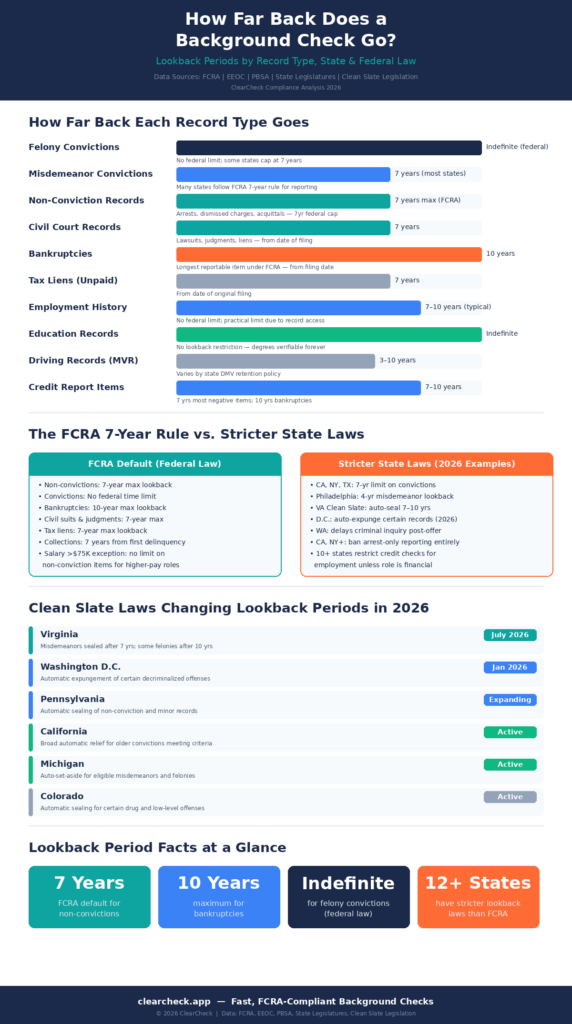
Criminal convictions: No time limit. Under federal law, a conviction — whether felony or misdemeanor — can be reported on a background check indefinitely.
Non-conviction records: Seven years maximum. This includes arrests that didn’t lead to conviction, dismissed charges, acquittals, and cases resolved through deferred adjudication. The seven-year clock starts from the date of the disposition (the outcome), not the date of the arrest.
Bankruptcies: Ten years from the filing date — the longest reportable item under the FCRA. (Do bankruptcies show up on background checks? Here’s the full picture.)
Civil suits and judgments: Seven years from the filing date.
Tax liens (unpaid): Seven years from the filing date.
Collections accounts: Seven years from the date of first delinquency.
The salary exception: If the candidate’s anticipated annual salary is $75,000 or more, the FCRA’s seven-year limit on non-conviction records does not apply. This means for higher-paying positions, arrests without conviction, civil judgments, and other non-conviction items can be reported beyond seven years.
This is the starting point. But it’s only half the story — because many states have enacted laws that are significantly stricter.
For a complete guide on what each record type reveals regardless of lookback period, see ClearCheck’s article on what a background check shows.
How Far Back Does a Background Check Go by Record Type?
Different types of records follow different lookback rules. Here’s the breakdown.
Criminal Convictions
Federal law: No limit — reportable indefinitely.
State exceptions: Several states limit how far back convictions can be reported, regardless of severity. California, New York, Texas, Kansas, Maryland, Massachusetts, Montana, New Hampshire, New Mexico, and Washington limit conviction reporting to seven years (with some exceptions for certain offenses or salary thresholds). Philadelphia’s amended Fair Criminal Record Screening Standards, effective January 2026, reduced the misdemeanor lookback from seven years to four.
Clean Slate laws (2026): Virginia began automatically sealing many misdemeanor convictions after seven years and certain felonies after ten years, effective July 2026. Washington D.C. started phasing in automatic expungement of certain records in January 2026. Pennsylvania continues expanding its automatic record-sealing provisions. Once sealed, these records should not appear on compliant screening reports — effectively shortening the lookback period to zero for qualifying offenses.
Arrests and Non-Conviction Records
Federal law: Seven years from the date of disposition.
State exceptions: Many states go further. California, New York, and several others ban the reporting of arrests that didn’t result in conviction entirely — not just within the seven-year window, but at any time. This means if you were arrested but never convicted, a compliant screening provider in these states will not report the arrest at all — but the rules for how an arrest shows up on a background check vary widely by state.
This distinction matters enormously. The EEOC has consistently held that arrest records — without a conviction — should generally not be used to deny employment, because an arrest is not proof of guilt. The Cornell Law Institute’s overview of the FCRA provides additional detail on these protections.
Credit History
Federal law: Seven years for most negative items (late payments, collections, charge-offs). Ten years for bankruptcies. No limit for positive information.
State exceptions: Some states restrict the use of credit history in employment decisions entirely unless the position directly involves financial responsibility. California, Colorado, Connecticut, Hawaii, Illinois, Maryland, Oregon, Vermont, Washington, and others have enacted credit check restrictions.
Employment and Education History
Federal law: No time limit. Your employment and education history can be verified as far back as records exist.
Practical limit: Most employers verify the last seven to ten years of employment history, simply because older records become increasingly difficult to access. Former employers may no longer exist, HR departments may not have records going back decades, and the relevance of very old employment diminishes.
Education records have no lookback restriction at all. A degree earned 30 years ago is still verifiable and still reportable.
Driving Records (MVR)
Lookback: Three to ten years, depending on the state. Each state’s DMV maintains its own policies for how long violations and incidents remain on a driving record.
State Laws That Change the Answer
The FCRA sets the federal minimum, but more than a dozen states have enacted stricter lookback limits. If you’re an employer or a candidate, the state where the job is located (not where the candidate lives) typically determines which rules apply.
Here are the most significant state-level restrictions in 2026:
California: Limits the reporting of convictions to seven years for positions paying below a defined salary threshold. Bans reporting of arrests without conviction. Restricts credit checks for employment.
New York: Seven-year limit on conviction reporting. NYC’s Fair Chance for Housing Act restricts criminal history consideration in tenant screening. Ban-the-box law applies statewide.
Texas: Seven-year lookback for certain records. First statewide ban-the-box law took effect September 2025, requiring employers with 15+ employees to delay criminal history inquiries.
Virginia: Clean Slate law effective July 2026 automatically seals qualifying misdemeanors after seven years and certain felonies after ten years. Once sealed, records are non-reportable.
Washington D.C.: Second Chance Act phasing in automatic expungement starting January 2026.
Philadelphia: Amended Fair Criminal Record Screening Standards effective January 2026 reduced misdemeanor lookback to four years and narrowed which convictions landlords and employers can consider.
Washington State: Updated Fair Chance Act effective July 2026 requires employers to delay criminal history inquiries until after a conditional offer and mandates individualized assessments.
The trend is clear: lookback windows are shrinking. More records are being sealed automatically. And employers who don’t use a compliant screening provider risk acting on information that is no longer legally reportable.
ClearCheck automatically applies the correct state and federal lookback rules to every search, so you never see — or act on — non-reportable records.

The Clean Slate Factor: How 2026 Laws Are Shortening Lookback Periods
Clean Slate laws represent the most significant shift in background check lookback periods in decades. These laws automatically seal or expunge qualifying criminal records after a defined waiting period — without the individual needing to petition a court.
Here’s what this means practically:
A misdemeanor conviction that would have appeared on a background check indefinitely under federal law may now be automatically sealed after seven years in Virginia, or automatically expunged in Washington D.C. Once sealed, the record should not appear on any compliant screening report — effectively reducing the lookback period to zero for that specific offense.
States with active or expanding Clean Slate laws in 2026 include California, Pennsylvania, Virginia, Michigan, D.C., Colorado, Connecticut, Delaware, Minnesota, and Oklahoma. More states are expected to follow.
For employers, this means the answer to “how far back does a background check go?” is literally changing month by month as new records become sealed. A search that would have returned a result six months ago may return nothing today — not because the record was deleted, but because it was automatically sealed under new legislation.
This is why using a compliant provider matters. ClearCheck’s searches automatically exclude sealed and expunged records, so you’re never making decisions based on information that’s been removed from public access.
For more on the evolving compliance landscape, see ClearCheck’s guide to background screening solutions.
What Candidates Can Do About Old Records
If you’re a candidate concerned about what might appear on a background check, here are actionable steps.
Run a check on yourself first. ClearCheck lets you run a background check on yourself to see exactly what an employer would see. If there’s something inaccurate or outdated, you’ll have time to address it before it surprises you.
Check if you qualify for expungement or sealing. Many states now offer expanded pathways to seal or expunge old records — including automatic sealing under Clean Slate laws. Contact your state’s legal aid organization or public defender’s office to find out if your records qualify.
Dispute inaccuracies. If a background check report contains incorrect information — a record that’s been expunged but still appears, a record attributed to someone else with a similar name, or outdated information — you have the right under the FCRA to dispute it. The screening company must investigate and resolve the dispute within 30 days.
Prepare to explain, not hide. If you have a conviction that will appear on a background check, don’t wait for the employer to discover it. Research shows that candidates who proactively address their record and provide context — time since the offense, rehabilitation, relevance to the role — fare better than those who stay silent.
For a full understanding of what gets reported, see what a background check consists of.

Common Misconceptions About Background Check Lookback Periods
“Everything from my past will show up.” Not true. The FCRA limits most non-conviction records to seven years, bankruptcies to ten, and many states impose additional restrictions. Sealed and expunged records should never appear.
“If I was arrested, employers will see it forever.” In most states, arrests without conviction are either limited to seven years or banned from reporting entirely. Several states prohibit arrest-only reporting at any lookback period.
“Lookback periods are the same everywhere.” Not even close. Federal law sets the floor, but more than a dozen states have stricter rules — and the applicable state depends on where the job is located.
“Old records don’t matter.” They can — especially for felony convictions in states without lookback limits. But the EEOC requires employers to conduct individualized assessments, considering the nature of the offense, time elapsed, and relevance to the job.
“Clean Slate laws delete my record.” Not exactly. Clean Slate laws seal records from public access — meaning they don’t appear on background checks. But the records still exist in the court system and may be accessible in limited circumstances (law enforcement, certain government positions).

The Bottom Line: The Answer Changes Depending on Where You Are and What You Did
How far back does a background check go? The federal answer: seven years for most non-conviction records, ten for bankruptcies, and indefinitely for convictions. But the practical answer depends on the state, the record type, the salary level, and whether Clean Slate laws have sealed the record.
In 2026, lookback periods are actively shrinking. More records are being sealed automatically than at any point in American history. And the penalties for reporting non-reportable records are growing.
For employers and landlords: using a compliant screening provider that automatically applies current lookback rules isn’t a convenience — it’s a legal necessity. For candidates: understanding your rights and running a self-check before the job search puts you in control.
ClearCheck handles both sides — accurate results for employers, transparency for candidates, and automatic compliance with every state and federal lookback rule.
Don’t Guess the Lookback Period — Let ClearCheck Get It Right
Background check laws are changing faster than ever. One wrong record on a report can cost you a lawsuit — or a great hire. ClearCheck automatically applies the correct lookback rules for every state, every record type, every time. Starting at $19.99, no contracts, no risk.
Your next screening decision is only as good as the compliance behind it.