
Picture this.
You just nailed the interview at your local Home Depot. The hiring manager smiled, talked about your start date, and said the words every job seeker wants to hear: “We’d love to have you on the team.” You walk out to your car already picturing the orange apron.
Then comes the email: “Your offer is contingent on a background check and drug screening.”
And your stomach tightens. Because maybe there’s something back there. An old misdemeanor. A charge that was dropped but might still show up. A gap in your employment history you’d rather not explain. Suddenly that orange apron feels a little further away.
Here’s some perspective: Home Depot employs more than 500,000 associates across over 2,300 stores — and every single one of them passed a background check to get there. You’re not walking an unusual path. You’re walking a well-worn one, and thousands of people with imperfect records have walked it successfully.
So let’s answer the question directly. Does Home Depot do background checks? Yes — on every applicant. But what they check, what might disqualify you, how long it takes, and how to prepare are the details that actually decide your outcome.
This guide breaks it all down.
Does Home Depot Do Background Checks? Yes — Here’s How
Let’s settle the headline question first.
Yes, Home Depot does background checks on every prospective employee. It’s a non-negotiable, standard part of the hiring process. Like virtually every major U.S. employer, Home Depot performs a background check on any potential hire, and you cannot be hired without completing one.
Home Depot doesn’t run these checks in-house. It uses a third-party background screening company — a consumer reporting agency — to do the actual searching. To run the check, you’ll need to provide your Social Security number, full legal name, residential address, and email address.
Here’s where the timing matters. Home Depot is a “ban the box” employer, which means it has removed the criminal-history checkbox from its application. So you won’t be asked about convictions up front. Instead, the background check happens after your interview, typically once you’ve received a conditional job offer — making it one of the last steps before you officially start.
Think of the background check as the final gate, not the first hurdle. By the time it runs, the company already likes you. The check is there to confirm what you’ve told them and to flag anything that genuinely matters for the role — not to ambush you.
Here’s exactly what’s behind that gate.
What Does a Home Depot Background Check Look For?
Now here’s the part applicants really want to know.
A Home Depot background check isn’t a single search — it’s a bundle of screenings, and the exact mix depends on the position you’re applying for. Here’s what it can include.
Criminal History Check
This is the core of it. Home Depot’s background check reviews local, state, and federal criminal databases across the country, looking for felonies, misdemeanors, warrants, and drug charges. In some cases, the federal database can even pull incidents that occurred outside the country.
For most entry-level retail roles, this criminal search is the main event. To understand exactly how these records are pulled and verified, see ClearCheck’s what shows up on a background check guide.
Employment and Education Verification
Home Depot will verify the employment history you listed on your application — confirming where you worked and when. In states that permit disclosure of termination reasons, being fired from a prior job can potentially appear. This is why honesty on your application matters: discrepancies between what you wrote and what the check finds are a common, avoidable red flag.
Motor Vehicle Records (For Driving Roles)
If the position involves driving — delivery, certain warehouse or fleet roles — Home Depot will pull your motor vehicle record (MVR) to review your driving history, including any DUIs or serious violations. If you’re worried about a DUI specifically, ClearCheck’s guide on whether a DUI shows up on a background check explains how driving offenses appear and for how long.
Credit Check (For Management Roles)
Most retail positions don’t involve a credit check. But some management candidates — especially those handling significant cash or financial responsibility — may have their credit history reviewed, including bankruptcies and outstanding debts.
Professional License Verification
For contracted or specialized services like HVAC or plumbing, Home Depot will likely verify that you hold the professional license the role requires.
Does Home Depot Drug Test?
Let’s address the other half of that conditional-offer email.
Yes, Home Depot drug tests. New hires are typically required to pass a drug screening during the onboarding process, and many locations require it before you can begin working in your new position. The drug test and the background check usually run in parallel as the final pre-employment steps.
And it doesn’t stop at hiring. Home Depot’s Code of Conduct states the company will terminate anyone found using illegal drugs at any time, or alcohol while on the job. Existing employees can be subject to random drug testing, particularly in safety-sensitive roles involving heavy equipment or power tools.
The takeaway: plan to be clean for the pre-employment screen, and understand that it’s an ongoing expectation, not a one-time hurdle.
Does Home Depot Hire Felons? The Ban-the-Box Reality
Here’s the question that brings a lot of anxious searchers to this page — and the answer is more encouraging than you might expect.
Yes, Home Depot hires people with felony records for many positions. As a ban-the-box company that has signed onto fair-chance hiring principles, Home Depot has pledged to give people with criminal records a genuine shot by treating them like any other applicant.
What Ban the Box Actually Means for You
Because Home Depot banned the box, your application won’t ask whether you’ve been convicted of a crime. You’ll be welcomed into the interview process and evaluated on your qualifications first — before any criminal history enters the picture. That’s a meaningful advantage: you get to make your case as a candidate before a record can color the decision.
When the background check does run, Home Depot weighs prior charges carefully rather than auto-rejecting. A felony conviction is not an automatic disqualifier for most roles — though certain serious offenses may bar you from certain positions.
How a Record Is Actually Evaluated
Home Depot uses the EEOC’s framework — sometimes called the “Green Factors” — to evaluate the relevance of a criminal record. That means weighing the nature and gravity of the offense, how much time has passed, and how the offense relates to the specific job. A decade-old misdemeanor unrelated to retail work is treated very differently from a recent, directly relevant conviction.
If you have a felony on your record, one smart move is to speak with HR early in the process about the circumstances. Getting ahead of it — explaining the context and your growth since — can keep a charge from becoming a silent disqualifier. For the full framework on how records are weighed, see ClearCheck’s felony background check guide.

How Long Does a Home Depot Background Check Take?
Let’s talk timing — because the waiting is usually the worst part.
Most Home Depot background checks are completed within a few business days to about a week, though the exact timeline varies. For applicants with clean, easy-to-verify records, it can move quickly. For others, several factors can stretch it out.
What Can Delay Your Check
- Slow court records — some county courts, especially in rural areas, process record requests slowly
- Common names — applicants with very common names often trigger extra verification to avoid false matches
- Multiple-state history — if you’ve lived in several states, each jurisdiction adds search time
- Identity mismatches — discrepancies in your SSN, name, or date of birth require manual review
- The drug test — results have to come back before the final offer, which can add a day or two
The “Colors” of a Home Depot Result
Here’s an insider detail. Home Depot’s screening results are often categorized using a color-coded system that signals whether an applicant is cleared, needs review, or is flagged. A clean result moves you straight to orientation. A flagged result triggers a closer look — and importantly, a flag is not an automatic rejection. It often just means the hiring manager needs to review the report before making the final call, similar to a “decisional” status on other screening platforms.
For more on how lookback windows affect what appears, see ClearCheck’s how far back a background check goes guide.
What the Research Says About Second-Chance Hiring
Here’s the bigger picture behind Home Depot’s fair-chance approach — and it’s genuinely debated among researchers.
On one side, research championed by institutions like MIT Sloan School of Management makes the business case for second-chance hiring: employees with records often show strong loyalty and retention, and most Americans support giving people with a blemish on their record another chance. The federal government even offers tax credits and fidelity bonds to encourage the practice.
But here’s where it gets interesting — and where most articles oversimplify.
Not all researchers agree that ban-the-box policies achieve their goal. A working paper from a research professor at the University of Chicago Harris School of Public Policy found that ban-the-box laws had essentially no effect — positive or negative — on employment for men with criminal backgrounds and less than a college degree. Other research has even suggested ban-the-box can unintentionally harm young Black men, because employers deprived of record information sometimes fall back on demographic assumptions instead.
What does this mean for you as an applicant?
It means ban the box gives you a real foot in the door — the chance to be evaluated on your merits first — but it doesn’t erase the background check itself. The check still happens. Your record still gets reviewed. So the winning strategy isn’t to hope a policy hides your history; it’s to know exactly what’s on your record and be ready to address it directly. That’s within your control, regardless of which side of the research debate proves right.
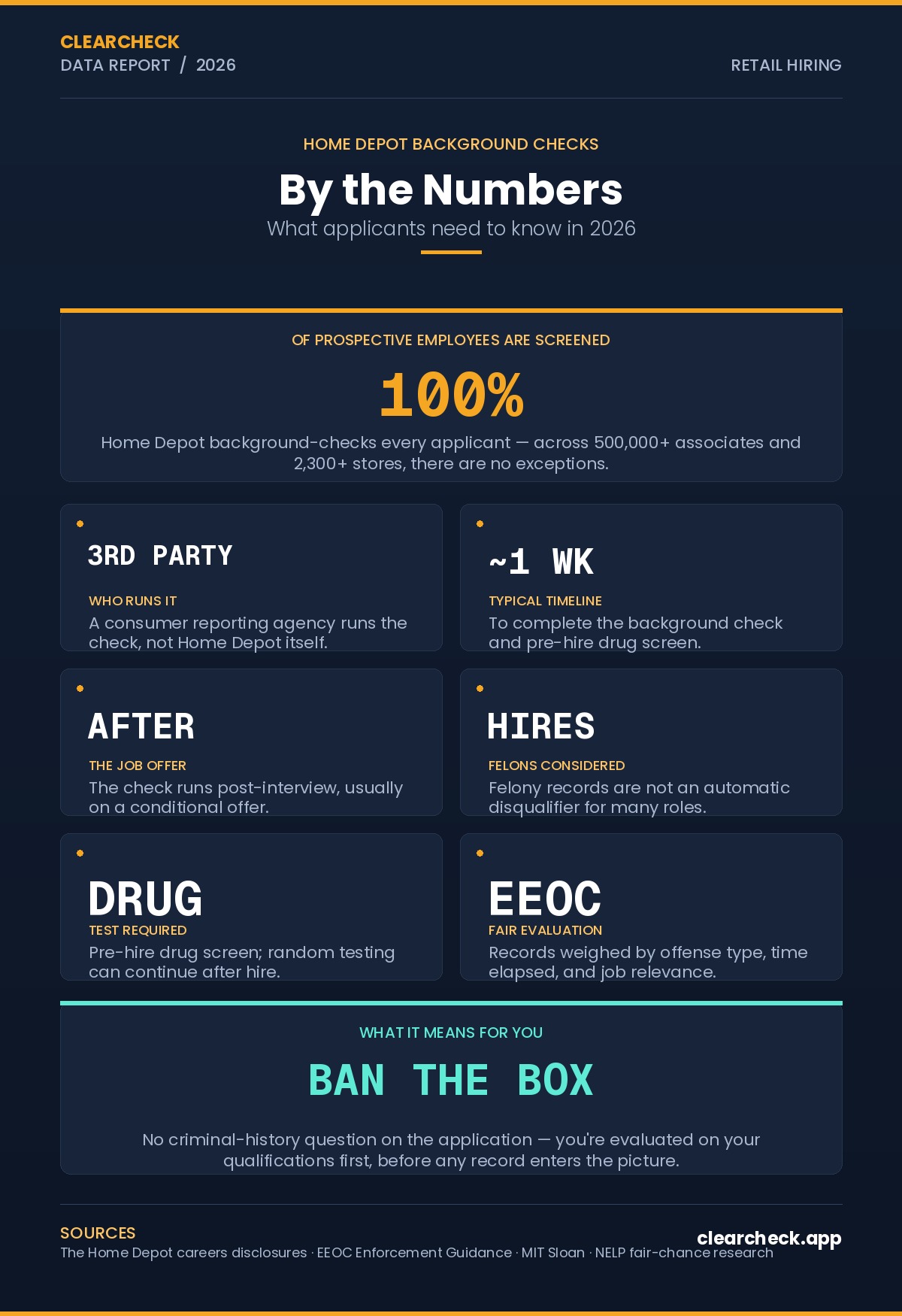
Visual Data Report: Home Depot Background Checks in 2026
Here is a snapshot of how Home Depot screening works and where it fits in retail hiring.
What Employers Can Learn From Home Depot’s Background Check Process
Here’s the other side of the screen — because Home Depot’s approach is a useful model for any business.
A retailer with half a million employees can’t afford to get hiring wrong, and the way Home Depot structures its screening offers a template worth studying.
Screen After a Conditional Offer
Home Depot runs its check after extending a conditional offer, not before the interview. This isn’t just compliance with ban-the-box laws — it’s good practice. It lets candidates be evaluated on merit first and reduces the risk of disparate-impact claims that arise when criminal history is used too early.
Apply the EEOC Framework, Not a Blanket Ban
By weighing records using the EEOC’s factors — offense type, time elapsed, and job relevance — rather than auto-rejecting anyone with a record, Home Depot keeps its hiring both fairer and more legally defensible. Blanket “no record” policies are exactly what invite EEOC scrutiny.
Follow FCRA Adverse Action to the Letter
When a record influences a hiring decision, Home Depot notifies the applicant per FCRA requirements, makes clear that the screening company only provided the report and wasn’t involved in the decision, and gives the candidate a chance to dispute inaccuracies. Any employer running checks needs this same adverse-action discipline. For a comparison of accurate, compliant screening providers, see the best criminal background check sites for employers in 2026.
How to Pass a Home Depot Background Check
Here’s your practical playbook — whether you’re applying for the first time or worried about something on your record.
Step 1: Run a Background Check on Yourself First
This is the single most valuable move. Before you apply, run your own background check using employer-grade data sources so you see exactly what Home Depot’s screening company will see. No surprises, no guessing. If something looks wrong, you have time to fix it before it costs you the offer.
Step 2: Fix Inaccurate or Incomplete Records
Background check errors are more common than people realize — a dismissed charge showing without its disposition, a record belonging to someone with your name, or an outdated entry that should have aged off. If you find one, dispute it. For records that ended without a conviction, ClearCheck’s guide on whether dismissed charges show up on a background check explains your right to correct the data.
Step 3: Be Honest on Your Application
Discrepancies between your application and the background check findings are a common, entirely avoidable reason for rejection. List your employment history accurately, and don’t exaggerate dates or titles. Honesty beats a mismatch every time.
Step 4: Get Ahead of Any Record
If you have a conviction that will appear, consider speaking with HR early about the circumstances. Home Depot evaluates records individually, so context and evidence of rehabilitation can keep a charge from becoming a dealbreaker.
Step 5: Be Patient
If your check is taking longer than expected, resist the urge to panic or assume the worst. Delays are usually about slow court records or identity verification, not something disqualifying. Reapplying with a second account or pestering the hiring manager won’t help.
Frequently Asked Questions About Home Depot Background Checks
Does Home Depot do background checks on all employees?
Yes. Home Depot conducts a background check on every prospective employee through a third-party screening company. You cannot be hired without completing one, and declining to consent ends the hiring process.
What does a Home Depot background check look for?
It reviews criminal history (local, state, and federal), verifies your employment history, and—depending on the role—may include a motor vehicle record check (for driving positions), a credit check (for some management roles), and professional license verification (for trades like HVAC or plumbing).
Does Home Depot hire felons?
Yes, for many positions. As a ban-the-box, fair-chance employer, Home Depot doesn’t ask about convictions on the application and evaluates records individually using EEOC factors. A felony isn’t an automatic disqualifier for most roles, though certain serious offenses may bar specific positions.
How long does a Home Depot background check take?
Usually a few business days to about a week. Delays can come from slow court records, common names, multi-state history, identity mismatches, or waiting on drug test results. Clean, easy-to-verify records move fastest.
Does Home Depot drug test?
Yes. New hires typically must pass a drug screening during onboarding, and many locations require it before you start. Existing employees can face random drug testing, especially in safety-sensitive roles.
How far back does a Home Depot background check go?
It depends on your state. Some states limit background check reporting to seven years, while others allow convictions to be reported indefinitely. Some applicants have reported records appearing from the last ten years. State law is the main factor.
Can I see my Home Depot background check before I apply?
You can’t see Home Depot’s specific report in advance, but you can run a background check on yourself using the same types of data sources to know exactly what will appear — and fix any errors before they affect your application.
The Bottom Line on Home Depot Background Checks
Here’s the honest summary.
Does Home Depot do background checks? Yes — on every applicant, through a third-party screening company, after a conditional offer. The check covers criminal history and employment verification, with driving records, credit, and license checks added depending on the role. There’s also a drug test. And because Home Depot is a ban-the-box, fair-chance employer, you’ll be evaluated on your qualifications first, with records weighed individually rather than auto-rejected.
For applicants, the lesson is empowering: most imperfect records don’t automatically disqualify you, felons are genuinely considered for many roles, and the single smartest thing you can do is check your own record first so you walk in with no surprises and a plan to address anything that’s there.
For employers, Home Depot’s process — screen after the offer, apply EEOC factors, follow FCRA adverse action — is a solid template for fair, defensible hiring.
Either way, the foundation is the same: an accurate, current, fully verified background check. That’s what ClearCheck delivers — fast, FCRA-compliant reports built on authoritative records, so whether you’re checking yourself before a Home Depot application or screening workers for your own business, you see the full, accurate picture.
See Exactly What Your Background Check Shows — Starting at $19.99
The worst time to discover a surprise on your background check is after Home Depot already has.
Whether you’re about to apply and want to know exactly what the screening will reveal, or you run a business that needs accurate, FCRA-compliant data to make fair hiring decisions, you need the real picture before it matters. ClearCheck delivers fast background checks built on current, authoritative court records — in 30 seconds, starting at $19.99 per check. No contracts. No setup fees.
Stop guessing and walk into that conditional offer knowing exactly where you stand. Run your check today.
Limited-time launch pricing on all four tier packages. Set up your account and run your first check in under five minutes.