Picture this.
You’ve just submitted your Instacart shopper application. The promise is appealing: flexible hours, shop on your own schedule, get paid weekly. You’re already imagining which neighborhoods you’ll cover and how you’ll fit batches around your day.
Then the screen says: “We’re running your background check. This may take a few days.”
And your stomach drops a little. Because maybe there’s something on your record. A speeding ticket from years ago. A misdemeanor you’d almost forgotten. A dismissed charge that never went anywhere. Suddenly the question isn’t when do I start — it’s will I even get the chance?
Here’s the reality: with roughly 16% of Americans having earned money through online gig platforms like grocery delivery, according to Pew Research Center, millions of people have stood exactly where you’re standing. And the single most-Googled question among them is simple.
Does Instacart do background checks? The short answer is yes — absolutely. But what they check, what disqualifies you, how long it takes, and how to prepare are the details that actually matter.
This guide breaks it all down — for prospective shoppers and for the customers who let those shoppers into their lives.
Does Instacart Do Background Checks? Yes — Here’s How
Let’s answer the headline question directly.
Yes, Instacart does background checks on every prospective shopper and driver. It’s a mandatory part of the onboarding process. No one joins the Instacart shopper network without passing one first. And it doesn’t stop there — Instacart also re-runs background checks on active shoppers periodically to catch anything new.
Instacart doesn’t conduct these checks itself. Like most gig platforms, it outsources screening to specialized third-party consumer reporting agencies. According to Instacart’s own platform integrity disclosures, prospective shoppers must complete and pass initial criminal and motor vehicle record background checks conducted by third-party partners.
Here’s why this matters so much to Instacart.
When a shopper accepts a batch, they’re stepping into a position of real trust — handling someone’s groceries, payment information, and often delivering directly to a customer’s doorstep or even inside their home. Instacart is staking its brand and its customers’ safety on every single shopper. A weak screening process would be a liability disaster.
Think of the background check as the front door to the entire platform. Everyone has to walk through it, the lock gets checked regularly, and the key is a clean enough record.
Here’s exactly what’s behind that door.
What Does an Instacart Background Check Look For?
Now here’s the part prospective shoppers really want to know.
An Instacart background check isn’t a single search — it’s a bundle of screenings designed to flag anything that could put customers, the platform, or other road users at risk. It generally breaks into two main categories.
Criminal History Checks
The criminal portion of the check searches public and private databases using your Social Security number. The process typically includes an SSN trace (to identify names and addresses associated with you), a sex offender registry search, and a search of national, state, and county criminal records.
The check focuses on flags like recent felony convictions, any violent crime, and patterns of criminal behavior indicating consistent recidivism. To understand how these criminal records are pulled and verified, see ClearCheck’s what shows up on a background check guide.
Motor Vehicle Record (MVR) Checks
Because full-service Instacart shoppers drive to stores and deliver to customers, the screening also pulls your motor vehicle record. This surfaces DUIs, moving violations, accidents, license suspensions, and reckless driving.
If you’re worried about a DUI specifically, ClearCheck’s guide on whether a DUI shows up on a background check covers exactly how driving-related offenses appear and how long they stick around.
What’s Usually NOT Included
Here’s some good news. Instacart background checks typically do not include juvenile records — Sterling, one screening partner, explicitly excludes them. Credit checks are generally not part of the standard shopper screening either, since the role isn’t a financial-fiduciary position.
What Disqualifies You From an Instacart Background Check?
This is the question that causes the most anxiety — so let’s be clear and specific.
Not every mark on your record is a dealbreaker. Instacart, like most gig platforms, weighs the severity and recency of offenses rather than applying a blanket ban on anyone with any history. That said, certain things will almost always disqualify you.
Common Disqualifiers
The offenses most likely to result in a failed Instacart background check include:
- Recent felony convictions — especially within the past 7 years
- Violent crimes — assault, battery, and similar offenses
- Sexual offenses — particularly anything requiring sex offender registration
- Theft and property crimes — directly relevant given shoppers handle goods and payments
- Major drug offenses — especially distribution or trafficking convictions
- Serious or recent driving violations — DUIs, reckless driving, driving with a suspended license
- Multiple violations — a pattern of offenses, even minor ones, can raise concerns
What Usually Won’t Disqualify You
On the flip side, many people pass with imperfect records. Items that often don’t automatically disqualify include old misdemeanors that fall outside the lookback window, minor traffic violations, dismissed charges with no conviction, and sealed or expunged records.
If you have a misdemeanor and you’re unsure how it’ll be treated, ClearCheck’s guide on whether misdemeanors show up on background checks breaks down how these offenses are weighed by recency and type.
The Recency Factor
Here’s the pattern worth understanding: recency matters enormously. A felony from 15 years ago followed by a clean record is treated very differently than a conviction from last year. Most gig platform screenings weigh both the seriousness of the offense and how long ago it occurred — which mirrors the EEOC’s individualized-assessment framework that responsible employers follow.

How Long Does an Instacart Background Check Take?
Let’s talk timing — because the waiting is often the hardest part.
Most Instacart background checks are completed within three to ten business days. For applicants with clean, easy-to-verify records, it can be even faster — sometimes just a couple of days.
But here’s what causes delays.
Why Your Check Might Be Taking Longer
Several factors can stretch the timeline beyond ten days:
- Slow court records — some county courts process record requests slowly, especially in rural jurisdictions
- Identity mismatches — if your SSN, name, or date of birth doesn’t cleanly match records
- Common names — applicants with very common names often trigger extra verification to avoid false matches
- Old or sealed records — these can appear and require manual review if databases haven’t been updated
If your check has stalled for weeks, you’re not alone — delayed Instacart checks are one of the most discussed topics in gig-work communities. Often the holdup is database lag or a records-matching issue rather than something disqualifying on your record.
What You Can Do While You Wait
The smartest move is to know what’s on your own record before you apply. If you run a self-check first, you’ll know exactly what the screening will surface — and you can spot errors (like a dismissed charge missing its disposition) before they delay or derail your application.
For context on how far back these checks typically reach, see ClearCheck’s how far back a background check goes guide.
How Instacart’s Ongoing Background Checks Work
Here’s something most prospective shoppers don’t realize.
Passing the initial background check isn’t a one-time event. Instacart runs ongoing, periodic re-checks on active shoppers to ensure they remain eligible. According to Instacart, the company refreshes background checks to confirm shoppers are still eligible to shop on the platform.
This means a shopper who passes today but picks up a serious conviction next year can be flagged and removed during a routine re-screen. For customers, this is a meaningful safety feature — it’s not just a one-and-done check at signup.
Beyond the Background Check: Identity Verification
Instacart layers additional security on top of the background check. The platform uses real-time identity verification, periodically prompting shoppers to take a live selfie that biometric screening technology matches against their government-issued ID. Shoppers must also maintain a verified profile photo, which is shared with customers so they can confirm the right person is at their door.
There are also anti-fraud measures like banned device switching (the device that accepts a batch must complete it) and periodic automatic logouts. Together, these create a layered trust system — the background check is the foundation, but it’s reinforced with continuous verification.
Why Background Checks Matter in the Gig Economy
Let’s zoom out for a moment, because this is bigger than Instacart.
The gig economy has reached a scale that’s genuinely hard to grasp. As documented in the Library of Congress research guide on the gig economy, researchers and government agencies now track workforce flexibility, platform usage, and job safety as core measures of this rapidly growing sector. The Bureau of Labor Statistics estimates millions of Americans rely on alternative work arrangements as their primary job, with tens of millions more participating part-time.
Here’s why screening is non-negotiable in this world.
Even though gig workers are independent contractors rather than traditional employees, the need for background checks is paramount. From a customer’s perspective, it makes no difference whether the person handling their groceries is a W-2 employee or a 1099 contractor — that worker represents the platform. Courts have repeatedly held companies liable for the actions of their workers, contractor status notwithstanding. The legal doctrine is negligent hiring, and it applies to gig platforms just as it applies to traditional employers.
That’s the dual purpose of an Instacart background check: it protects customers from harm, and it protects Instacart from the brand and legal fallout of an incident. The same logic applies to any business that puts a worker in front of a customer.
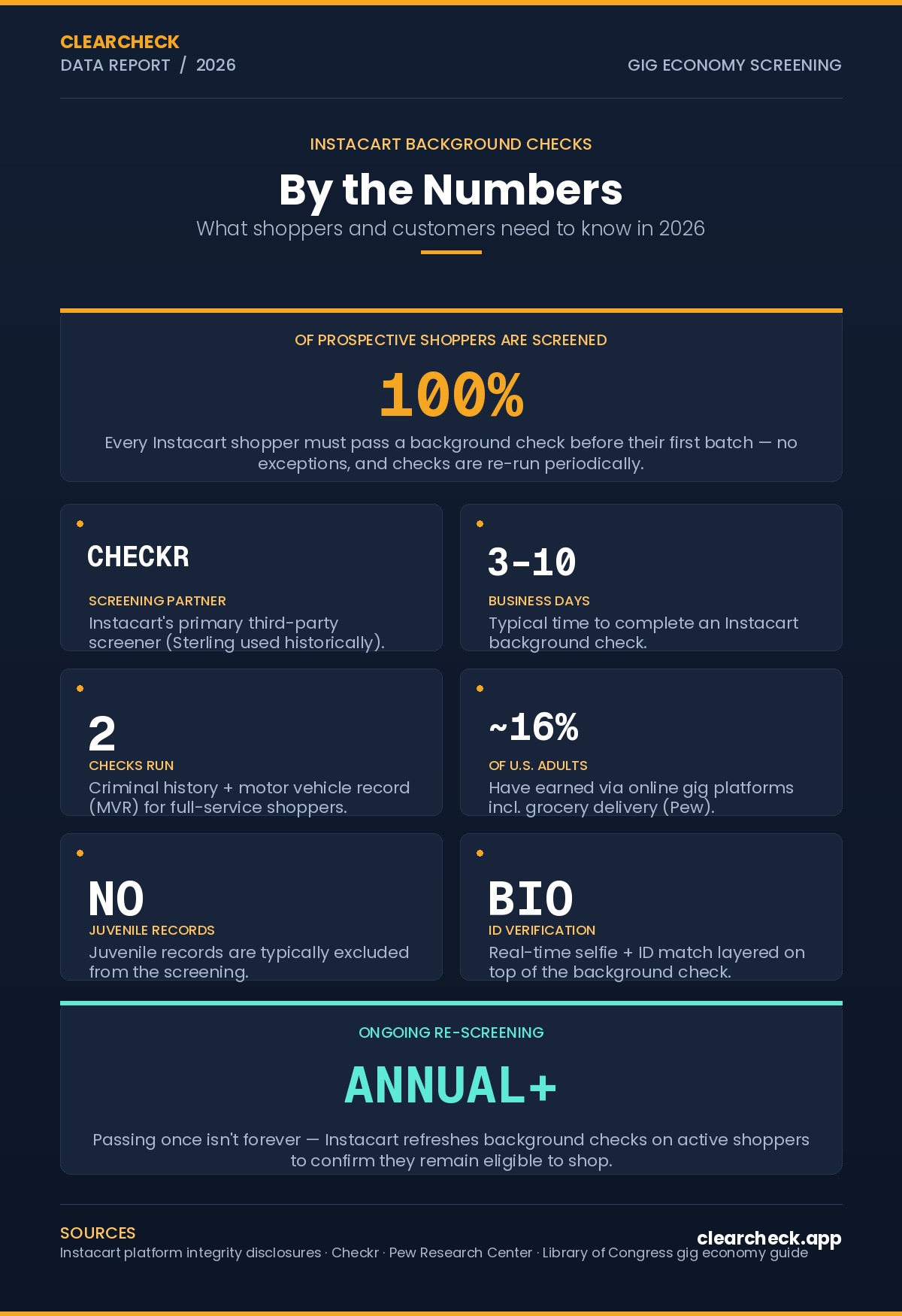
Visual Data Report: Instacart Background Checks in 2026
Here is a snapshot of how Instacart screening works and where it fits in the gig economy.
How to Pass an Instacart Background Check
Here’s the practical playbook — whether you’re applying for the first time or worried about a re-check.
Step 1: Run a Background Check on Yourself First
This is the single most valuable step. Before you apply, run a self-check using employer-grade data sources so you see exactly what Clearcheck will see. No surprises, no guessing. If something looks wrong, you have time to fix it before it costs you the opportunity.
Step 2: Fix Inaccurate or Incomplete Records
Background check errors are more common than people think — a dismissed charge showing without its disposition, a record belonging to someone with your name, or an outdated entry that should have aged off. If you find one, dispute it. For records that resulted in no conviction, ClearCheck’s guide on whether dismissed charges show up on a background check explains your right to correct the data.
Step 3: Consider Sealing or Expungement
If you have an old, minor offense that’s eligible, sealing or expungement can remove it from standard background checks entirely — clearing your path not just for Instacart but for future opportunities too.
Step 4: Be Honest and Patient
If the application gives you a chance to explain your history, take it. And if your check is taking longer than expected, resist the urge to panic or reapply with a second account — that violates Instacart’s policies and can get you banned outright.
Frequently Asked Questions About Instacart Background Checks
Does Instacart do background checks on all shoppers?
Yes. Every prospective Instacart shopper and driver must pass an initial criminal and motor vehicle record background check before they can start. Instacart also re-runs these checks periodically on active shoppers to confirm ongoing eligibility.
What company does Instacart use for background checks?
Instacart primarily uses Checkr, a leading third-party background check provider. Sterling has also been used historically. These companies pull criminal and driving records and report the results back to Instacart.
How long does an Instacart background check take?
Most are completed within three to ten business days. Delays can occur due to slow court records, identity mismatches, common names, or old records requiring manual review. Clean, easy-to-verify records can clear in as little as a couple of days.
What disqualifies you from being an Instacart shopper?
Common disqualifiers include recent felony convictions, violent crimes, sexual offenses, serious theft or property crimes, major drug offenses, and serious or recent driving violations like DUIs. Recency and severity both matter — old, minor offenses are often not disqualifying.
Can you work for Instacart with a misdemeanor?
Often, yes. A single old misdemeanor that falls outside the lookback window is frequently not disqualifying, especially if it’s minor and unrelated to theft, violence, or driving safety. Recent or serious misdemeanors are weighed more heavily.
Does Instacart background check look at driving record?
Yes, for full-service shoppers who drive. The motor vehicle record (MVR) check surfaces DUIs, moving violations, accidents, and license suspensions. In-store-only shoppers, who don’t drive for the platform, face less emphasis on driving history.
Can I see my Instacart background check before I apply?
You can’t see Instacart’s specific report in advance, but you can run a background check on yourself using the same types of data sources to know exactly what will appear. This is the best way to catch errors or surprises before they affect your application.
The Bottom Line on Instacart Background Checks
Here’s the honest summary.
Does Instacart do background checks? Yes — comprehensively. Every shopper is screened through a third-party partner like Clearcheck before they start, the screening covers both criminal history and driving records, and Instacart re-runs checks periodically to keep the platform safe. On top of that, biometric identity verification adds a continuous layer of trust.
For prospective shoppers, the lesson is empowering: most imperfect records don’t automatically disqualify you, recency and severity matter, and the smartest thing you can do is check your own record first so you walk in with no surprises.
For customers — and for any business owner reading this — the takeaway is bigger. The reason Instacart screens every shopper is the same reason every business that puts a worker in front of a customer should screen too: trust and safety aren’t optional, and negligent hiring is a real liability.
That’s exactly what ClearCheck delivers. Fast, FCRA-compliant background checks built on accurate, current records — so whether you’re checking yourself before a gig application or screening workers for your own business, you see the full, accurate picture.
Run Your Own Background Check in 30 Seconds — Starting at $19.99
Don’t let a background check surprise cost you the gig — or cost your business a bad hire.
Whether you’re about to apply as an Instacart shopper and want to know exactly what Clearcheck will see, or you run a business that puts workers in front of customers, you need the real picture before it matters. ClearCheck delivers fast, FCRA-compliant criminal and driving-record background checks in 30 seconds — built on accurate, current court records, starting at $19.99 per check. No contracts. No setup fees.
Know before they know. Run your check today and walk into your next opportunity with total confidence.
Limited-time launch pricing on all four tier packages. Set up your account and run your first check in under five minutes.