It was supposed to be a five-day cooling-off period. A nurse in Tampa had just received the verbal job offer of her career — a charge nurse role at a top-rated hospital with a $14,000 pay bump. On day three, her phone rang. The HR director’s voice was friendly but firm.
“We’re going to need to talk about something that came up on your background check.”
It was a single DUI. Eight years old. A first offense, completed probation, paid every fine, served every hour of community service. She had even forgotten the conviction was technically still on her record.
The hospital didn’t.
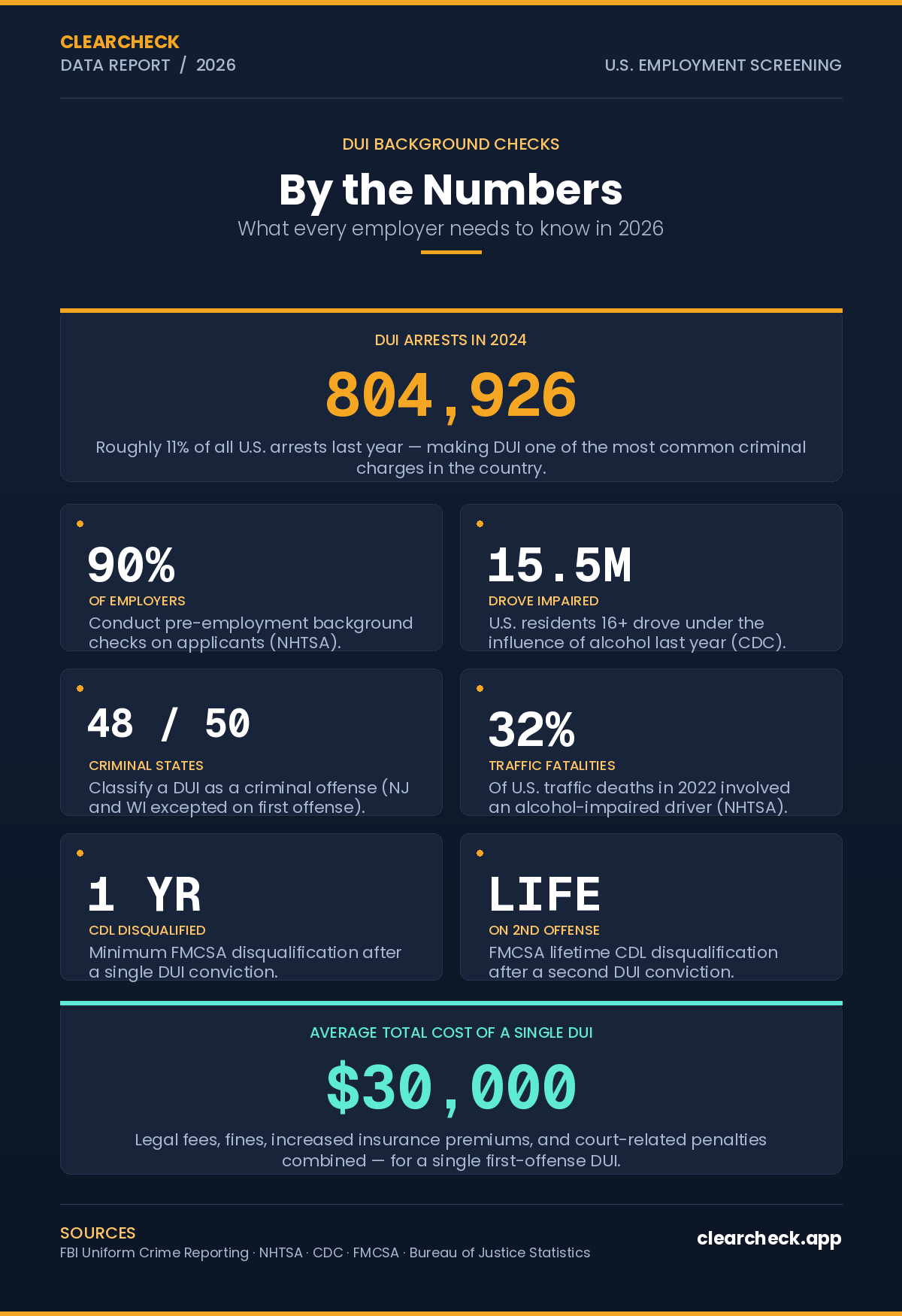
Here is what most candidates and most employers underestimate: roughly 804,926 Americans were arrested for DUI in 2024 — about 11% of all arrests nationwide — and the vast majority of those convictions will surface on a background check the moment someone runs one. Not five years from now. Not ten. Today.
So let’s answer the question that gets typed into search bars hundreds of thousands of times a year. Does a DUI show up on a background check? And what does it actually mean — for employers, for hiring decisions, and for the candidates whose careers hinge on the answer?
This guide breaks it down.
Does a DUI Show Up on a Background Check? The Short Answer
Let’s not bury the lead.
Yes — a DUI almost always shows up on a background check. A DUI conviction is a criminal offense in 48 of 50 states (we’ll get to the two exceptions), and that means it lives on a candidate’s permanent criminal record. When an employer runs a properly conducted screen, that conviction will appear.
But here is what most articles get wrong.
A DUI is unique among criminal offenses because it can show up in two completely separate places: on a criminal background check and on a motor vehicle record (MVR) check. Most employers run one. The most thorough employers run both. Either way, a DUI conviction is one of the hardest things on an applicant’s record to keep hidden.
Think of it this way: a typical misdemeanor lives in one filing cabinet — the county criminal court. A DUI lives in two. The criminal court has it. The DMV has it. Both are searchable. Both can surface independently. That doubled exposure is what makes the DUI such a persistent issue for job seekers years after the offense.
Here’s everything that determines what an employer actually sees.
Where DUIs Show Up: Criminal Records vs. Motor Vehicle Records
This is the part most candidates don’t understand until it’s too late.
There is no single “background check” — there are several. And a DUI can pop out of more than one of them. So when you ask, will my DUI show up?, the honest answer is yes, in at least one place, possibly two.
How a DUI Shows Up on a Criminal Background Check
In nearly every state, a DUI is prosecuted as a criminal offense — usually a misdemeanor for first-time offenders, sometimes a felony when aggravating factors apply (more on that in a moment).
That conviction is filed at the county court level, reported up to state criminal repositories, and eventually appears in national criminal databases.
A standard pre-employment criminal background check that searches county courts in the jurisdictions a candidate has lived — combined with statewide and national database searches — will surface a DUI conviction in seconds. Some employers also pull arrest records, in which case even a dismissed DUI charge may appear as part of the candidate’s arrest history.
For more on what a layered criminal screen actually pulls, see ClearCheck’s guide on what shows up on a background check.
How a DUI Shows Up on a Motor Vehicle Record (MVR)
Here is where it gets serious for anyone in a driving-related role.
A DUI also shows up on your state Department of Motor Vehicles record — separate from the criminal court system. The DMV tracks license suspensions, restrictions, revocations, points, and the underlying alcohol-related offense.
Most employers don’t pull MVR checks unless the role involves driving. But when they do — and any role with a fleet vehicle, delivery requirement, or commercial driving component absolutely will — the MVR is where a DUI hits hardest.
In California, for example, a DUI remains on your driving record for 10 years from the date of the incident. Other states vary, but the DMV lookback for DUIs is typically longer than the lookback for ordinary moving violations.
Is a DUI a Misdemeanor or a Felony? (And Why It Matters)
Here’s something most candidates and even some employers get wrong.
A DUI is not always a misdemeanor. And the difference between a misdemeanor and a felony DUI is the difference between a difficult conversation in an interview and a hiring disqualification for most roles.
When a DUI Is a Misdemeanor
In most states, a first-time DUI with no aggravating factors is charged as a misdemeanor. Typical features:
- No injuries to others
- No child in the vehicle
- BAC at or near the legal limit (.08 in most states; .05 in Utah)
- No prior DUI convictions on the candidate’s record
- Standard alcohol or drug impairment — not vehicular assault territory
A first-time misdemeanor DUI usually results in fines, probation, court-ordered alcohol education, license suspension, and possibly minimal jail time.
For a deeper look at how misdemeanors generally appear on background checks — including DUIs — see ClearCheck’s how far back a background check goes guide for state-by-state lookback periods.
When a DUI Becomes a Felony
Felony DUI charges typically trigger when one or more of these apply:
- Serious injury or death caused by the impaired driver
- Multiple prior DUI convictions (usually a third or fourth offense, depending on state)
- Extremely high BAC at the time of arrest (some states elevate at .15 or .20+)
- Child in the vehicle at the time of the offense
- Driving on a previously suspended license for a prior DUI
A felony DUI carries much heavier consequences — prison time, longer license revocation, and a permanent mark that follows the candidate through every background check for the rest of their life, unless successfully expunged.
For employers screening for senior roles or trust-sensitive positions, a felony DUI carries different implications than a misdemeanor. ClearCheck’s felony background check guide covers the framework for evaluating felony records in hiring decisions.
The Two States Where DUIs Are NOT Criminal
Here’s a quirk worth knowing.
New Jersey and Wisconsin are the only two states that do not classify a first-offense DUI as a criminal offense. In both states, a first DUI is treated as a traffic violation. The implication: candidates with first-offense DUIs from those states can technically answer “no” to the question “have you been convicted of a crime?” — but only if the offense occurred there and only on the first offense.
That said, the DUI will still appear on the candidate’s driving record, and it can still trigger employer concern. The “not a crime” framing is a legal technicality, not a free pass.

How Long Does a DUI Show Up on a Background Check?
This is the question that costs people sleep.
And the honest answer is more variable than most articles admit. Here’s how the timing actually works.
The Federal FCRA Baseline
The Fair Credit Reporting Act (FCRA) is the federal law that governs what consumer reporting agencies — including background check providers — can include on a report.
Under FCRA:
- Non-conviction information (arrests that didn’t lead to a conviction, dismissed charges) is generally limited to a seven-year reporting window for jobs paying under $75,000
- Convictions can be reported indefinitely under federal law — there is no automatic seven-year drop-off
That means in the absence of stricter state law, a DUI conviction can appear on background checks decades after the original offense.
State-by-State DUI Reporting Limits
A handful of states impose stricter rules than the federal baseline. A snapshot:
- California: 7 years for conviction reporting (Clean Slate Law also automatically seals most misdemeanor DUIs after 4 years if no new offenses); DUI stays on driving record for 10 years
- Texas: 7-year limit for positions under $75,000; no limit above
- New York: 7 years for most positions
- Washington: 7 years for all employment background checks
- Massachusetts: Misdemeanors limited to 3 years; felonies to 7
- Maryland: DUI convictions stay on criminal record permanently unless expunged
- Florida: DUI stays on driving record for 75 years (yes, you read that right)
Here is the key point most candidates miss: even when state law limits reporting by consumer reporting agencies, the underlying conviction still exists. A licensing board, a government background check, or a fingerprint-based check (like California Live Scan) can still surface it.
When a DUI Won’t Show Up on a Background Check
So we’ve established that a DUI almost always appears. But there are real scenarios where it doesn’t.
Here are the most common.
The conviction has been expunged or sealed. Expungement legally removes the conviction from the candidate’s public record. Once successfully expunged, a DUI should not appear on standard employment background checks. Eligibility, waiting periods, and process vary dramatically by state — and some states do not allow DUI expungement at all (or only allow it for first-offense misdemeanors).
The case was dismissed and the arrest record was sealed. A pending or dismissed DUI may still appear as an arrest until the candidate takes affirmative steps to seal it.
The search wasn’t deep enough. A national database search alone may miss a recent county-level DUI conviction that hasn’t yet been reported up to state and national databases. For the most reliable searches, see the best criminal background check sites for employers in 2026.
The state classifies DUI as a non-criminal offense. In New Jersey and Wisconsin, a first-offense DUI is a traffic violation, not a crime — meaning it won’t appear on a criminal background check. It will still appear on an MVR.
The lookback window has expired under state law. In states with strict reporting limits (California, Washington, etc.), a DUI conviction may legally drop off employment background checks after seven years — even though the conviction itself still exists.
Industries Where a DUI Hits Hardest on Background Checks
This is where the rubber meets the road.
A DUI is not just a hiring concern — for certain industries, it’s a regulated disqualification. Here are the roles where a DUI carries the most weight.
Commercial Driving (CDL Holders)
The Federal Motor Carrier Safety Administration (FMCSA) automatically disqualifies CDL holders from operating commercial vehicles for at least one year following a DUI conviction. A second offense? Lifetime disqualification.
For trucking, logistics, and any role requiring a CDL, a DUI is essentially a non-starter — at minimum for the disqualification period. Companies hiring CDL drivers cannot legally place a disqualified driver behind the wheel of a commercial vehicle.
Healthcare
Nursing boards, medical boards, and pharmacist licensing agencies all review criminal convictions during licensure and renewal. A single first-time misdemeanor DUI may not end a healthcare career, but multiple DUIs — or a DUI involving patient transport or fatalities — typically does. Many hospital employers also run ongoing background checks on clinical staff, meaning a current employee with a new DUI can face termination.
Education
K–12 districts and licensure boards conduct thorough background checks before hiring, often including FBI fingerprint-based checks. Many states require teachers and school employees to self-report any criminal charges. School transportation roles face additional scrutiny under FMCSA.
Government and Security Clearance
Federal positions, law enforcement roles, and any position requiring a security clearance involve extensive background investigations that look beyond the standard seven-year FCRA window. A DUI conviction won’t automatically disqualify a candidate from a clearance — but it does prompt deeper review of judgment and reliability.
Finance and Public Trust
Banks, financial advisors, and any role involving fiduciary responsibility may consider a DUI relevant to evaluating an applicant’s trustworthiness and judgment. Industry regulators like FINRA review criminal history during licensure.
For more on how to match screening depth to the role you’re hiring for, see ClearCheck’s overview of what a background check shows for employers and candidates.
What the Research Says About DUI Records and Employment
Here’s a finding from the academic literature that should reshape how employers think about older DUI records.
A peer-reviewed analysis published in Criminology & Public Policy, the journal of the American Society of Criminology and the College of Criminology & Criminal Justice at Florida State University, examined predictors of DUI recidivism across decades of data. The research consistently identifies a specific cluster of risk factors: current age, marital status, educational attainment, employment status, BAC at the time of arrest, number of prior DUI arrests, number of prior criminal arrests, and number of prior moving violations.
What does this mean for employers?
It means a single, old, isolated DUI — especially one followed by years of clean record, stable employment, and demonstrable rehabilitation — is statistically not the same risk profile as someone with multiple offenses or recent DUIs. The research supports what the EEOC has long required: individualized assessment, not blanket disqualification.
This is the framework modern background screening should operate within. Find the record. Evaluate it in context. Make a defensible decision.
Visual Data Report: DUI Background Checks in 2026
Here is a snapshot of where DUI screening sits in the current hiring landscape.
How Employers Should Handle a DUI on a Background Check
Here’s where most hiring managers either over-react or under-react.
A DUI showing up on a background check doesn’t make a hire-or-no-hire decision automatic. There’s a legal framework — and ignoring it is how negligent-hiring exposure and EEOC complaints get filed.
EEOC Individualized Assessment
Federal anti-discrimination law requires employers to conduct an individualized assessment when criminal history factors into a hiring decision. For a DUI, that means weighing:
- How long ago the offense occurred — a 12-year-old DUI carries different weight than a 12-month-old one
- The nature of the role — does the position involve driving, vulnerable populations, fiduciary access?
- Whether the candidate has demonstrated rehabilitation — clean record since, completed treatment programs, professional growth
- Whether there are aggravating factors — multiple DUIs, injuries, child endangerment
Blanket policies that disqualify anyone with any DUI are legally risky — particularly when they create disparate impact.
FCRA Adverse Action Procedures
If you decide not to hire based on a DUI surfaced through a background check, FCRA requires:
- Pre-adverse action notice — including a copy of the report and a summary of the candidate’s rights
- Reasonable time to dispute — typically five to seven business days
- Final adverse action notice — if you proceed with the decision
ClearCheck handles each of these steps within the platform, so you’re not assembling a compliance trail from scratch.
Running a Background Check That Actually Catches DUIs
Here’s the practical takeaway.
For employers who need a background check that reliably surfaces DUI history — not one that misses half of them — the search has to be designed correctly.
Step 1: Run Criminal History at Every Layer
Pull county-level court records from every county the candidate has lived in, layered with statewide repositories and national criminal database searches. Most DUI convictions live at the county court level first.
Step 2: Add an MVR Check for Driving-Adjacent Roles
If the role involves driving — even occasional use of a personal vehicle for company errands — pull the motor vehicle record. The MVR will surface DUI convictions that may be missed by criminal-only searches, plus license suspensions and restrictions.
Step 3: Verify Identity to Prevent False Positives
DUI records are sometimes attributed to the wrong person due to name and birthdate mismatches. Make sure your screening provider uses SSN verification and full identifying information — not just name and DOB.
Step 4: Use a Provider Built for Compliance
ClearCheck’s workflow handles FCRA disclosure, authorization, and adverse action automatically. Most checks return results in 30 seconds or less. National criminal database coverage, statewide seven-year searches, and MVR add-ons are available across all tiers.
Frequently Asked Questions About DUIs and Background Checks
Does a DUI show up on a background check after 7 years?
It depends on the state. Federal FCRA doesn’t limit conviction reporting to seven years. Some states (California, Washington, New York, and others) do impose seven-year reporting limits. In states without such limits, a DUI conviction can appear on background checks indefinitely unless expunged.
Does a DUI show up on a federal background check?
A federal background check pulls federal court records, so a DUI prosecuted at the state level (which is most DUIs) wouldn’t appear on a federal-only check. However, federal employment background checks for security clearance or government positions typically combine federal, state, and county searches — and will surface state DUI convictions.
Will a dismissed DUI show up on a background check?
A dismissed DUI may appear as an arrest record on some background checks — particularly those that include arrest history. Under FCRA, arrests not leading to conviction are generally limited to a seven-year reporting window for jobs under $75,000. Some states prohibit reporting of non-conviction arrests entirely. Expungement or sealing is the most reliable way to remove a dismissed DUI from public records.
Does a pending DUI show up on a background check?
Yes, in most jurisdictions a pending DUI charge will appear on a criminal background check that searches court records. Some states (like Kentucky) restrict reporting of pending charges. If the case is still in progress, the report will typically show it as “pending” rather than a conviction.
Can I get a job with a DUI on my record?
In most cases, yes — but it depends on the industry, the role, the recency of the DUI, and the employer’s policies. Most non-driving, non-licensed roles are achievable with an old, isolated DUI, especially when the candidate is honest, prepared to discuss it, and can demonstrate rehabilitation. Commercial driving, healthcare, education, and security clearance roles face the steepest barriers.
Will a DUI show up on a background check if I move to a different state?
Yes. A DUI conviction in one state will appear on national criminal database searches conducted from any other state. The conviction follows you. Some states share DMV data through the Driver License Compact, meaning even your driving record may follow when you transfer your license.
How can I find out if a DUI shows up on my background check before applying for jobs?
Run a check on yourself. ClearCheck’s self-check workflow uses the same data sources employers use — so you see exactly what they’ll see, and have the chance to address any inaccuracies or surprises before an employer raises them.
The Bottom Line on DUIs and Background Checks
Here’s the honest summary.
Does a DUI show up on a background check? Almost always — yes. It appears on criminal background checks. It appears on motor vehicle records. It can appear for years, and in many states, indefinitely. It hits hardest in driving-related, healthcare, education, government, and trust-sensitive industries.
For employers, the question is not whether to look. It’s whether your screening process is rigorous enough to catch what’s actually there — and structured enough to evaluate it fairly when it surfaces.
For candidates, the question is not whether your DUI will appear. It’s whether you can address it honestly, demonstrate growth, and find employers who weigh the whole candidate against a single data point from years ago.
ClearCheck was built for both sides of that equation. Fast, FCRA-compliant background checks that catch every DUI conviction — and a workflow that supports the legal framework employers need to make defensible hiring decisions.
Run a DUI Background Check in 30 Seconds — Starting at $19.99
One missed DUI is one negligent-hiring lawsuit waiting to happen.
If you’re hiring drivers, delivery staff, in-home technicians, healthcare workers, or anyone with access to your customers and assets, you cannot afford to skip the DUI check. ClearCheck returns FCRA-compliant criminal background and MVR results in 30 seconds — no contracts, no setup fees, and pricing that starts at $19.99 per check.
The hospital in Tampa caught the DUI before it became a problem. You can be that employer too.
Or you can hire blind and hope.
Limited-time launch pricing on all four tier packages. Set up your account and run your first check in under five minutes.