Here’s a number that should stop you cold.
According to research cited by the Center for American Progress, only about 6.5% of Americans who are eligible to clear their criminal records actually complete the process within five years of qualifying. Researchers call this the “second chance gap” — the vast canyon between the millions of people legally entitled to a clean record and the tiny fraction who ever get one.
But here’s the part that’s even more surprising.
Many of the people who do go through the trouble — who pay the fees, file the petitions, and win a court order sealing their record — discover something deeply frustrating later on: their sealed record showed up on a background check anyway.
How is that possible? If a judge sealed it, shouldn’t it be invisible?
Not always. And understanding why is the difference between a candidate who walks into an interview confident and one who gets blindsided by a record they thought was gone for good.
So let’s answer the question directly. Do sealed records show up on background checks? The honest answer is layered — and it’s one of the most misunderstood topics in the entire screening industry.
This guide breaks it all down.
Do Sealed Records Show Up on Background Checks? The Honest Answer
Let’s cut straight to it.
In most cases, no — a properly sealed record will not appear on a standard employment background check. That’s the entire point of sealing. A sealed record is hidden from public view, which means the general public, landlords, schools, licensing boards, and most private employers cannot see it.
When a record is sealed, in most states you can legally answer “no” if asked whether you’ve been convicted of a crime. Many states explicitly bar employers from making hiring decisions based on sealed records — which means, in practice, it’s actually better for hiring managers not to even know.
But — and this is the crucial caveat that trips up thousands of people every year — “sealed” does not mean “destroyed.”
A sealed record still exists. It’s locked away, not erased. And under specific circumstances, that locked door can be opened: by an FBI fingerprint check, by a database that didn’t get the update, by certain regulated industries, or by a court order to unseal.
Think of it like a book removed from the public library shelves and placed in a locked archive. The book still exists. Most people will never find it. But the right person, with the right key, in the right circumstances, can still pull it off the shelf.
Here’s exactly when that happens.
Sealing vs. Expungement: Why the Difference Decides Everything
Before we go further, we have to clear up the single biggest source of confusion on this topic.
People use “sealed” and “expunged” interchangeably. They are not the same thing — and the difference directly determines whether a record can resurface on a background check.
What Sealing Actually Means
Sealing hides a record from public view without destroying it. The record still exists in court and law enforcement systems. It’s simply restricted from public access. Government agencies, law enforcement, and certain authorized entities can still access a sealed record under specific conditions.
Sealing locks the record up. Expungement, in theory, throws it away.
What Expungement Actually Means
Expungement — called “expunction” in some states like Texas — is the legal process of erasing or destroying a record entirely, as though the offense never occurred. In a true expungement, the record is permanently destroyed and no longer exists in any system.
Here’s the catch: true expungement isn’t available in every state. California, for example, doesn’t offer true expungement — what it calls “expungement” (under Penal Code 1203.4) actually functions more like sealing, with the record dismissed but not destroyed. Other states destroy records completely.
Why This Distinction Matters for Your Background Check
A truly expunged (destroyed) record is far less likely to ever resurface, because there’s nothing left to find. A sealed record — which still exists — has multiple pathways to reappear: database lag, FBI checks, regulated industry exceptions, and court-ordered unsealing.
For a deeper look at how different record types behave on screens, see ClearCheck’s what shows up on a background check guide.
When Sealed Records DO Show Up on Background Checks
Now here’s the part most people underestimate.
Even after a judge signs the sealing order, there are several well-documented scenarios where a sealed record still surfaces on a background check. Knowing these is critical for both candidates and employers.
FBI Fingerprint-Based Background Checks
This is the big one.
The FBI is a federal agency, and it is under no obligation to honor a state court’s order to seal. When an employer runs an FBI fingerprint-based background check — pulling from the National Crime Information Center (NCIC) and Interstate Identification Index (III) — a state-sealed record may still appear.
The FBI may, as a courtesy, seal the record from its database. But it doesn’t have to. FBI fingerprint checks are typically required for jobs in banking, federal employment, law enforcement, childcare, eldercare, healthcare, and education. In those fields, a state-sealed record can still surface.
Database Lag and Third-Party Data Brokers
Here’s a frustrating reality of the screening industry.
When a court seals a record, it updates its own system. But the conviction may have already been scraped and sold to dozens of third-party criminal history databases — the kind many cheap background check companies rely on. Those private databases often don’t receive the sealing update.
As a result, sealed records frequently still appear on background checks pulled from outdated third-party databases. The court’s records show nothing — but the data broker’s stale copy still has the old conviction.
This is precisely why search quality matters so much. For a comparison of reliable screening sources versus bargain database scrapers, see the best criminal background check sites for employers in 2026.
Regulated Industries and Level 2 Checks
Certain industries are legally permitted to see sealed records.
Jobs involving vulnerable populations — children, the elderly, people with disabilities — often require “Level 2” background checks that can access sealed records under specific statutory exceptions. Sealed records involving the mistreatment of children or other vulnerable individuals may be legally reportable in these enhanced checks.
Court-Ordered Unsealing
A sealed record isn’t necessarily sealed forever.
Under specific circumstances — typically “in the interest of justice” or for an ongoing criminal investigation — a judge can order a sealed record unsealed. Once unsealed, the record can appear on subsequent background checks, and the individual may be required to disclose it again.

How Clean Slate Laws Change Whether Sealed Records Show Up
Here’s where the law is shifting fast.
A growing number of states have passed “Clean Slate” laws — legislation that automatically seals (and in some cases expunges) eligible criminal records after a waiting period, without the individual having to file anything.
This matters enormously for the question of whether sealed records show up on background checks.
How Clean Slate Sealing Works
Clean Slate laws use technology to identify eligible records and automatically seal them once conditions are met — typically a set number of conviction-free years. No petition, no legal fees, no court appearance required.
Under New York’s Clean Slate Act, for example, a misdemeanor is sealed three years after release (eight years for a felony), provided the person has stayed out of trouble and is not on probation or parole. California’s SB 731 automatically seals many records after sentence completion and a waiting period.
What Clean Slate Laws Don’t Do
Here’s the critical limitation. As the Brookings Institution explains, although some statutory language uses the word “expungement,” clean slate laws typically seal criminal records only from publicly accessible databases. Criminal histories remain accessible to law enforcement agencies and continue to exist in most federal databases.
In other words: Clean Slate sealing protects you from the public and most private employers — but the record still exists and can still surface through the FBI and regulated-industry channels described above.
The Exceptions Built Into Clean Slate Laws
Most Clean Slate laws have built-in carve-outs. Records remain viewable by law enforcement, during fingerprint background checks, and for people working with children, the elderly, or other vulnerable populations. And the most serious offenses — murder, sex offenses requiring registration — are typically never eligible for sealing at all.
For a broader look at how long different records remain visible, see ClearCheck’s how far back a background check goes guide.
What the Research Says About Sealed Records and Employment
Here’s a finding from the academic literature that reframes the entire conversation.
Research from the Paper Prisons Initiative — an empirical research project housed at Santa Clara University — coined and measures the “second chance gap.” Their landmark study, America’s Paper Prisons: The Second Chance Gap, published through Santa Clara University School of Law, documented that the overwhelming majority of people eligible for record relief never receive it — often because they don’t know they’re eligible, can’t afford the process, or can’t navigate the paperwork.
Why does this matter for employers and candidates?
Two reasons.
First, for candidates: even if your record was eligible to be sealed, it may not have been sealed automatically. Many people walk around assuming a record is gone when no one ever actually sealed it. The only way to know for certain is to check.
Second, for employers: the research underscores why the EEOC requires individualized assessment. Records that should have been sealed — minor, old, nonviolent offenses — frequently still appear on cheap database checks. Treating every database hit as disqualifying punishes exactly the people the law intended to give a second chance, and creates disparate-impact liability.
The research is clear: people with old, minor records are no more likely to reoffend than people with no record at all. A stale database hit on a sealed offense is not a reliable signal of anything.
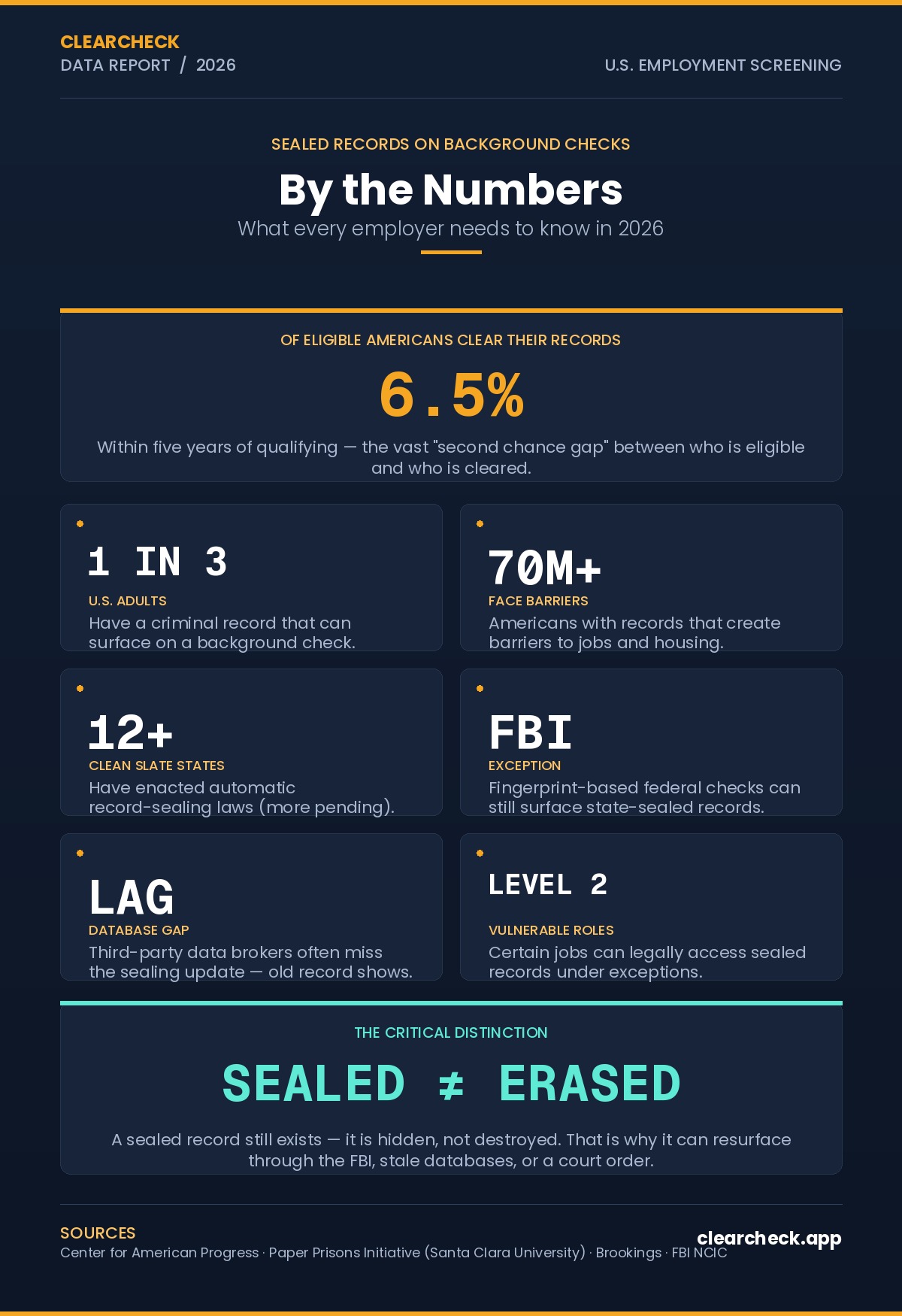
Visual Data Report: Sealed Records and Background Checks in 2026
Here is a snapshot of the sealed records landscape.
What Employers Should Know About Sealed Records on Background Checks
Here’s where compliance gets serious.
If a sealed record surfaces on a background check — through database lag, an FBI check, or any other channel — an employer’s obligations don’t disappear just because the data appeared. In fact, acting on a sealed record you weren’t legally entitled to see can create real liability.
Many States Prohibit Using Sealed Records in Hiring
This is the part employers most often get wrong.
In many states, it is illegal to make a hiring decision based on a sealed record — even if it shows up on your report. Some states bar employers from even asking about sealed records unless the role falls under a specific statutory exception (like working with vulnerable populations). If a sealed record appears on a screen for a role where you’re not legally entitled to consider it, the safest move is to disregard it entirely.
FCRA and Adverse Action Still Apply
If a record surfaces and influences a hiring decision, the Fair Credit Reporting Act adverse action process applies: pre-adverse action notice, a copy of the report, reasonable time to dispute, then a final adverse action notice. The dispute window is especially important with sealed records, because it gives the candidate a chance to demonstrate the record was sealed and should never have appeared.
Use a Screening Partner That Honors Sealing
The single best way to avoid sealed-record liability is to use a screening provider that pulls from current court records — not stale third-party database scrapes that miss sealing updates. This protects both the candidate’s rights and your legal exposure.
For the framework on evaluating any concerning record fairly, ClearCheck’s felony background check guide covers the EEOC individualized-assessment standard that applies here too.
How Candidates Can Check Whether a Sealed Record Will Show Up
Here’s the practical advice for anyone worried about a sealed record.
The single smartest thing you can do before a job search is run a background check on yourself. This tells you exactly what an employer will see — including whether a record you believe was sealed is still surfacing through a stale database somewhere.
Step 1: Confirm the Record Was Actually Sealed
Don’t assume. Because of the second chance gap, many people who are eligible for sealing were never actually sealed. Pull your own criminal history from the court to confirm the order went through.
Step 2: Run a Self-Check Using Employer-Grade Sources
A self-check using the same data sources employers use reveals whether the sealing propagated to the databases screeners actually pull from. If a sealed record still appears, you can address it proactively — by disputing the stale data or by being prepared to explain it.
Step 3: Know Your State’s Disclosure Rules
In most states, you can legally deny a sealed record on a job application. But certain regulated roles (those involving vulnerable populations, firearms, or security clearance) may legally require disclosure. Know which category your target job falls into.
Step 4: Use a Provider Built for Accuracy
ClearCheck pulls from current, authoritative court records and runs FCRA-compliant searches that return in 30 seconds or less. For candidates, that means an accurate picture of what employers see. For employers, it means a screen that honors sealing orders and minimizes the risk of acting on records you’re not entitled to consider.
Frequently Asked Questions About Sealed Records and Background Checks
Do sealed records show up on FBI background checks?
Sometimes, yes. The FBI is a federal agency and is not legally bound by a state court’s sealing order. On a fingerprint-based FBI check (pulling from NCIC and III), a state-sealed record may still appear. The FBI may seal it as a courtesy, but it isn’t required to.
Do sealed records show up on standard employment background checks?
Usually not. A properly sealed record is hidden from public view, so standard private-employer background checks generally won’t show it. The main exceptions are database lag (where a third-party data broker missed the sealing update) and FBI/regulated-industry checks.
What’s the difference between sealed and expunged records on a background check?
A sealed record still exists but is hidden from public access — it can resurface through FBI checks, stale databases, or court order. An expunged (truly destroyed) record no longer exists in any system and is far less likely to ever reappear. Note that some states, like California, don’t offer true expungement.
Can employers legally use a sealed record against me?
In many states, no. It’s often illegal to base a hiring decision on a sealed record, and some states prohibit employers from even asking about them unless the role qualifies for a statutory exception. If a sealed record surfaces for a role where the employer isn’t legally entitled to consider it, they should disregard it.
Why did my sealed record still show up on a background check?
The most common reason is database lag — the conviction was scraped and sold to third-party criminal history databases before it was sealed, and those private databases never received the update. Running a check from current court records (rather than stale database copies) usually resolves this.
Do I have to disclose a sealed record to an employer?
In most states and for most jobs, no — you can legally deny a sealed record. However, certain regulated roles involving vulnerable populations, firearms, or security clearance may legally require disclosure. When in doubt, consult an employment attorney familiar with your state’s rules.
Does a sealed record show up on a background check after a Clean Slate law seals it?
Clean Slate sealing protects you from the public and most private employers, but the record still exists. It can still surface through FBI fingerprint checks and for roles involving vulnerable populations, since Clean Slate laws include built-in exceptions for those channels.
The Bottom Line on Sealed Records and Background Checks
Here’s the honest summary.
Do sealed records show up on background checks? Usually not on standard private-employer screens — that’s the whole point of sealing. But “sealed” means hidden, not erased, and several real pathways can bring a sealed record back into view: FBI fingerprint checks, stale third-party databases, regulated-industry exceptions, and court-ordered unsealing.
For candidates, the lesson is clear: don’t assume. Confirm your record was actually sealed, then run a self-check to see whether the sealing propagated everywhere it needs to.
For employers, the lesson is equally clear: many sealed records that surface on cheap database checks are records you’re legally barred from using — and acting on them creates liability. The safest, most compliant approach is a screen built on current court records that honors sealing orders.
ClearCheck was built for exactly that. Fast, FCRA-compliant background checks pulled from authoritative, current sources — protecting candidates’ rights and employers’ compliance at the same time.
Run an Accurate, Compliant Background Check in 30 Seconds — Starting at $19.99
Acting on a record you weren’t legally allowed to see is a lawsuit waiting to happen.
Cheap database-scraper background checks routinely surface sealed records that should never appear — and using them can expose your business to real liability. ClearCheck pulls from current, authoritative court records, runs fully FCRA-compliant searches, and returns results in 30 seconds — starting at $19.99 per check. No contracts. No setup fees.
Don’t gamble your hiring decisions on stale, inaccurate data. Know exactly what’s real — and what’s legally yours to consider.
Limited-time launch pricing on all four tier packages. Set up your account and run your first check in under five minutes.