
He thought it was buried.
A 34-year-old project manager in Denver had a temporary restraining order filed against him during a contentious divorce four years earlier. It expired without incident. He hadn’t violated it. The marriage ended. He moved on.
Then came the dream job — a $145,000 senior role at a healthcare technology company, contingent on a background check. He didn’t disclose the restraining order. He didn’t think he had to. After all, it was a civil matter, not a criminal one. It wasn’t a conviction. He hadn’t been arrested.
Two weeks later, the offer was withdrawn. Not because of what showed up on the background check, but because of what didn’t — and what he failed to disclose anyway.
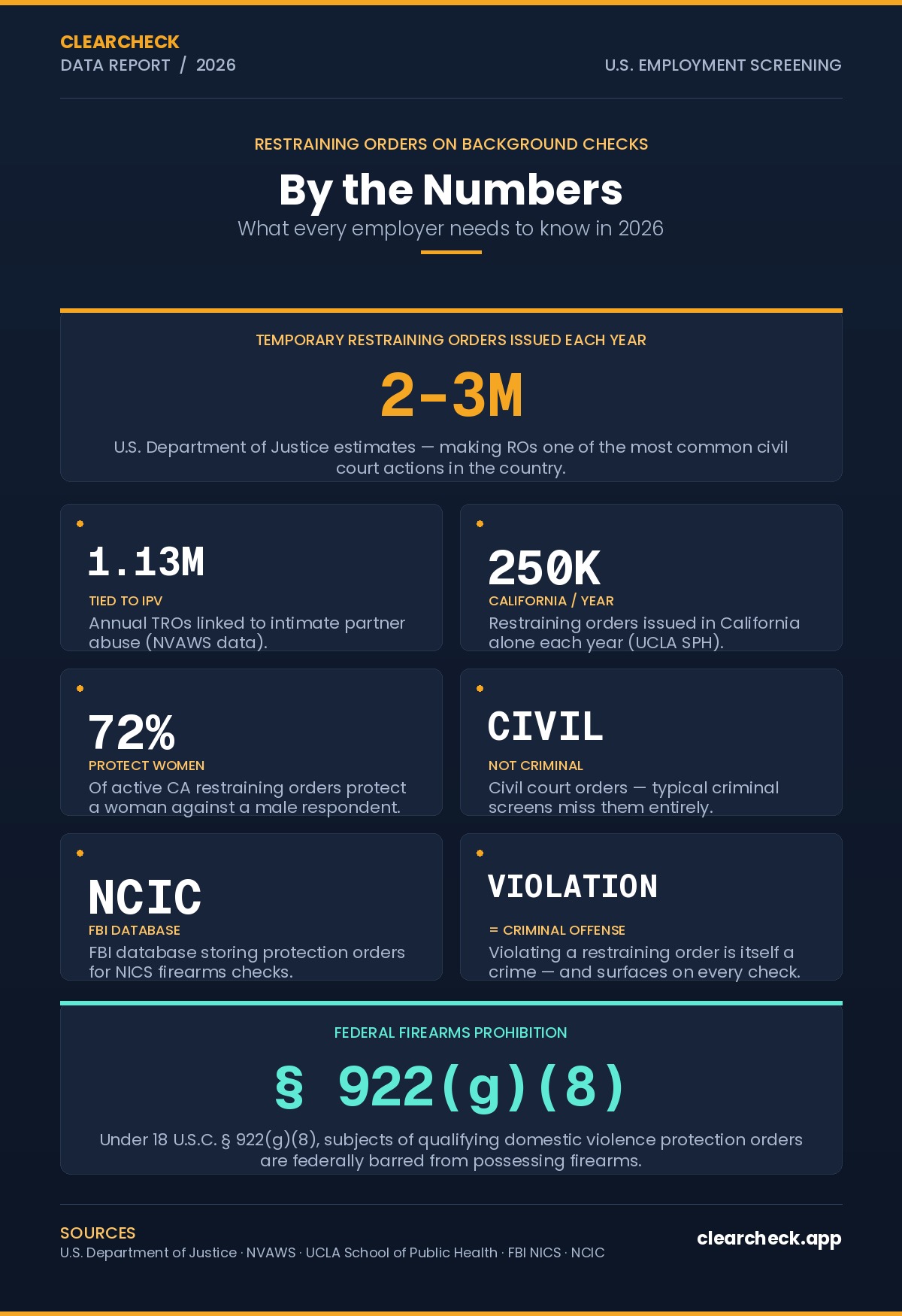
Here’s the part most people don’t realize: an estimated two to three million temporary restraining orders are issued in the United States every year, according to U.S. Department of Justice data. And the question of whether they appear on a background check is one of the most misunderstood corners of the entire screening industry.
So let’s settle it. Do restraining orders show up on background checks? And what does that actually mean — for employers running screens, and for candidates whose civil court history could quietly tank an offer?
This guide covers it all.
Do Restraining Orders Show Up on Background Checks? The Civil Records Twist
Let’s not waste time.
The honest answer is: usually no on a standard criminal background check — but yes on several other types of checks that employers run regularly.
Here’s the distinction that breaks most articles on this topic: a restraining order is a civil court order, not a criminal conviction. That single fact is the source of nearly all the confusion. Criminal background checks pull criminal court records — convictions, pending charges, sometimes arrests. They are designed to surface criminal activity. A civil restraining order, by definition, is not part of that record.
So if an employer runs only a basic criminal background check, a restraining order against a candidate typically won’t appear.
But — and this is the big but — most employers don’t stop at criminal records. Many screens include civil court record searches. Some industries require NICS or fingerprint-based federal background checks. And restraining order violations are themselves criminal offenses, which means they absolutely do appear.
Think of it like a parked car versus a moving violation. The parking ticket (civil) lives in one filing cabinet. The speeding ticket (criminal) lives in another. Most people only check the second cabinet — unless they have a reason to open the first.
Here’s what determines what actually shows up.
Understanding Restraining Order Types (Why Each One Matters)
Before we go further, we need to clear something up.
There is no single “restraining order.” There are at least five distinct types, each with different durations, different visibility on background checks, and different employment implications. Knowing which one is on a candidate’s record changes everything about how an employer should evaluate it.
Temporary Restraining Orders (TROs)
These are emergency orders, often issued ex parte — meaning without the restrained party being present in court. A TRO typically lasts a few weeks until a full hearing can be held. They’re issued quickly to address immediate threats and are usually visible only to law enforcement during their short duration.
Emergency Protective Orders (EPOs)
Issued by law enforcement, often at the scene of a domestic disturbance, and typically lasting only a few days until a court hearing. Even shorter visibility than TROs.
Permanent Restraining Orders
Despite the name, these usually aren’t permanent — they typically last one to five years, with options for renewal. Permanent restraining orders carry the most weight on background checks. They’re often entered into state and federal protection order registries, and they trigger the NICS firearms prohibition we’ll get to shortly.
Domestic Violence Restraining Orders (DVROs)
A subset of permanent ROs specifically arising from domestic violence allegations. These carry the heaviest weight — federal law explicitly prohibits firearm possession by subjects of qualifying DVROs.
Civil Harassment Orders
These cover non-domestic situations — neighbors, coworkers, strangers, online stalkers. They’re typically narrower in scope than DVROs and often don’t trigger federal firearms prohibitions.
How Restraining Orders Appear on Different Background Checks
Now here’s the part that catches employers off guard.
The visibility of a restraining order on a background check depends almost entirely on which type of check you’re running. Let’s break it down by search type.
Standard Criminal Background Checks
A typical pre-employment criminal background check pulls county court criminal records, state criminal repositories, and national criminal database matches. Because restraining orders are civil — not criminal — they generally don’t appear on these searches.
If you’re running a standard ClearCheck Basic or Standard package and the candidate has only a civil restraining order with no underlying criminal charges, the report will likely come back clean on the RO question. That doesn’t mean the order doesn’t exist. It means a criminal search isn’t designed to find it.
For a deeper breakdown of what a typical criminal screen does (and doesn’t) catch, see ClearCheck’s what shows up on a background check guide.
Civil Court Records Searches
This is where restraining orders show up loud and clear.
Civil court records are public — and many employers, especially in regulated industries, run civil records searches in addition to criminal screens. A civil records search will surface restraining orders, lawsuits, civil judgments, evictions, and other civil court actions tied to a candidate’s name.
Court records may display active and expired orders in the individual’s past, depending on the jurisdiction. In states like California and Wisconsin, restraining orders are entered into statewide registries and remain searchable for years.
NICS Firearms Background Checks
This is where the rules change dramatically.
The National Instant Criminal Background Check System (NICS), operated by the FBI, is required for all firearm purchases through licensed dealers. NICS pulls from the National Crime Information Center (NCIC), which specifically includes protection order data.
Under federal law (18 U.S.C. § 922(g)(8)), a person subject to a qualifying domestic violence protection order is federally prohibited from purchasing or possessing a firearm during the order’s active duration. This includes any candidate applying for a role that requires firearm possession — armed security, law enforcement, certain federal positions, and so on.
The protection order doesn’t have to be a felony. It doesn’t have to involve a criminal conviction. The civil order itself triggers the prohibition.
Specialized Industry Background Checks
Healthcare, education, government, and security-cleared roles often require deeper screening that includes civil court records, professional license verification, and sometimes fingerprint-based checks. In these industries, even an old civil restraining order can surface.
For a complete picture of how a layered background check is built, see ClearCheck’s what a background check shows guide.

When Restraining Orders DO Show Up on a Criminal Background Check
Here’s the scenario most candidates underestimate.
While a restraining order itself is a civil matter, several related situations do generate criminal records that appear on standard criminal background checks. Knowing these distinctions is critical for both candidates and employers.
Restraining order violations. If a candidate has violated a restraining order — and was arrested or charged for that violation — the violation appears as a criminal offense on background checks. Violating a restraining order is typically a misdemeanor on first offense, escalating to a felony with repeat violations or aggravating factors. This is one of the most common ways restraining orders end up surfacing on criminal screens.
Criminal court-issued protective orders. When a restraining order is issued by a criminal court as a condition of bail, release, or sentencing — rather than by a civil court — the underlying criminal case appears on background checks. The protective order itself may also be flagged depending on the search depth.
Permanent orders entered into protection order registries. Many states maintain protection order registries that integrate with state criminal record systems. In some jurisdictions, particularly California and Wisconsin, even a civil restraining order shows up alongside criminal records on broader searches.
Domestic violence convictions linked to a DVRO. When a DVRO accompanies a domestic violence arrest or conviction, the criminal case is what appears on the report — but the DVRO context often surfaces in tandem.
For more on how layered criminal screens catch what database-only searches miss, see the best criminal background check sites for employers in 2026.
How Long Restraining Orders Show Up on Background Checks
The duration question is where state law variation gets wild.
Here’s the framework.
Temporary Restraining Orders (TROs) typically remain visible only during their active period — usually two to four weeks until the permanent hearing. Once expired without a permanent order being issued, they often drop off most non-law-enforcement searches.
Permanent Restraining Orders are typically active for one to five years and remain visible on civil court records throughout that duration — and often after. Public court records of issued restraining orders may remain accessible for many years beyond the order’s expiration date, depending on the jurisdiction.
Expungement of restraining orders is possible in some states but requires affirmative legal action. The process and eligibility vary widely. Some states allow restraining order records to be sealed after the order expires; others don’t.
State variation snapshot:
- California: ROs entered in DVROS registry, accessible to law enforcement and some employer searches; civil court records remain public indefinitely
- Massachusetts: ROs generally do not appear on standard CORI (Criminal Offender Record Information) employer background checks but remain on civil court records
- New York: Orders of protection entered in statewide registry; civil court records publicly accessible
- Florida: Injunctions for protection appear in clerk of court records and are publicly searchable
- Texas: Protective orders in civil court records and entered in NCIC for qualifying DV orders
For a state-by-state lens on background check lookback windows generally, see ClearCheck’s how far back a background check goes guide.
NICS, Firearms, and the Federal Protection Order Rule
This is the angle that catches the most employers — and candidates — off guard.
Under the Brady Handgun Violence Prevention Act and 18 U.S.C. § 922(g)(8), a person who is the subject of a qualifying protection order is federally prohibited from purchasing, possessing, or transporting a firearm during the active duration of that order. This prohibition is automatic and federal — it applies regardless of state law.
Here’s what “qualifying” means:
- The order must be issued after a hearing where the respondent had notice and an opportunity to participate (ex parte temporary orders generally don’t qualify under the federal statute)
- The order must restrain the respondent from harassing, stalking, or threatening an intimate partner or that partner’s child
- The order must include either an explicit finding that the respondent represents a credible threat, or explicit terms prohibiting use, attempted use, or threatened use of physical force
When a candidate applies for any role that requires firearm possession — armed security guard, law enforcement, federal protective service, certain bonded delivery roles — the NICS check pulls protection order data from the National Crime Information Center (NCIC). If a qualifying protection order is active, the federal firearms prohibition kicks in.
NICS retains records of disqualifying protection orders for the duration of the order. Once the order expires or is dismissed, NICS purges the disqualifying record — meaning the federal firearms prohibition lifts. But the underlying civil court record itself doesn’t disappear from court systems.
This is a critical compliance point for any employer hiring into roles that touch firearms.
Visual Data Report: Restraining Orders on Background Checks in 2026
Here is a snapshot of the restraining order screening landscape.
What the Research Says About Restraining Orders
Here’s a finding from the academic literature that should reshape how employers evaluate restraining order history.
A peer-reviewed analysis published in the Penn State Journal of Law and International Affairs examined the effectiveness of protective orders across multiple longitudinal studies. The researchers found that most survivors feel safer once a protection order is in place, and the data fairly concludes that protective orders are at least somewhat effective at preventing escalating violence. But — critically — outcomes vary widely, and a restraining order alone is not a reliable predictor of either future conduct or character.
What does this mean for employers?
It means a restraining order on a candidate’s record is contextual evidence, not a verdict. The order itself was issued on a preponderance-of-evidence standard (typically), often ex parte for temporary orders, often during emotionally charged divorces or family disputes. An old restraining order — particularly one that expired without renewal or violation — is fundamentally different from a recent permanent DVRO accompanied by criminal charges.
The EEOC’s guidance is clear: evaluate the totality of the circumstances, the nature of the role, the time elapsed, and whether the order is relevant to the job’s specific requirements. Don’t disqualify based on the existence of a civil order alone.
What Employers Should Know About Restraining Orders on Background Checks
Here’s where most hiring managers either miss the signal or over-react to it.
A restraining order is not the same as a criminal conviction. It’s not proof of wrongdoing. It is a court determination that the petitioner met a legal standard sufficient for civil intervention — often, but not always, supported by underlying violence or threats.
So how should an employer think about restraining orders that surface on a screen?
Distinguish Civil Orders From Criminal Records
A restraining order without an accompanying criminal charge or conviction tells you the petitioner met a civil standard. It doesn’t tell you the respondent committed a crime. EEOC guidance and federal anti-discrimination law require employers to make hiring decisions based on relevant criminal history — not civil disputes that may have no bearing on the role.
Consider Whether the Order Is Job-Relevant
For roles involving vulnerable populations, firearms, or trust-sensitive positions, an active or recent protection order is materially relevant — and the employer has a legitimate basis to evaluate it. For roles where the order has no bearing (a remote software engineering role with no customer contact, for example), drawing conclusions from a civil order is legally risky and often unjustified.
Follow FCRA Adverse Action Procedures
If a restraining order surfaces on a screen and influences your hiring decision, the FCRA adverse action process applies. Pre-adverse action notice, a copy of the report, reasonable time to dispute, then a final adverse action notice. This isn’t optional — it’s federal law.
For the broader framework of evaluating concerning records during hiring, ClearCheck’s felony background check guide covers the EEOC individualized assessment framework that applies equally to non-conviction information like protection orders.
Running a Background Check That Actually Surfaces Restraining Orders
Here’s the practical part.
For employers who need a background check that reliably finds restraining order history — not one that misses civil court records entirely — the search needs to be designed correctly.
Step 1: Layer in Civil Court Record Searches
Standard criminal-only searches will miss most civil restraining orders. For roles where this matters — healthcare, education, fiduciary positions, anything involving vulnerable populations — add civil court record searches in the jurisdictions where the candidate has lived.
Step 2: Pull NICS or Fingerprint-Based Checks for Firearm Roles
For any role requiring firearm possession, a NICS check (or fingerprint-based federal background check that pulls NCIC data) is essential. These will surface qualifying protection orders that trigger federal firearms prohibitions.
Step 3: Don’t Stop at the National Database
National criminal databases are aggregations, and they routinely miss civil records entirely. County-level civil court searches are the gold standard for surfacing restraining order history.
Step 4: Use a Provider Built for Compliance
ClearCheck’s screening workflows handle FCRA disclosure, authorization, and adverse action documentation automatically. National criminal database coverage, statewide criminal records, civil records add-ons, and sex offender registry searches return in 30 seconds or less.
Frequently Asked Questions About Restraining Orders and Background Checks
Do temporary restraining orders show up on background checks?
Usually not on standard criminal background checks. TROs are short-duration civil orders, often issued ex parte, and they typically don’t appear in criminal databases. They may, however, appear in civil court records searches and in state protection order registries while active.
Will a restraining order show up if it was dismissed?
If a restraining order petition was filed but never granted, or was dismissed before being made permanent, it may still appear in civil court filings as a record of the petition. Many employers searching civil records will see the filing itself, even if no order was ultimately issued. Sealing or expungement of the civil filing may be available depending on the state.
Does a restraining order affect getting a job?
It depends on the role, the industry, and the type of restraining order. For most general roles, a civil restraining order with no underlying criminal charges and no violations is unlikely to be the determining factor. For roles involving firearms, vulnerable populations, fiduciary trust, or security clearance, it can carry significant weight.
Do restraining orders show up on NICS gun background checks?
Yes — qualifying domestic violence protection orders are entered into the NCIC database and surface on NICS firearms background checks. Under federal law (18 U.S.C. § 922(g)(8)), a person subject to a qualifying protection order is federally prohibited from purchasing or possessing a firearm during the order’s active duration.
Do I need to disclose a restraining order on a job application?
It depends on what the application asks. Most applications ask about criminal convictions — and a civil restraining order is not a criminal conviction. However, if the application asks about civil judgments, court orders, or anything that might affect your ability to perform the job (such as firearm possession for a security role), honest disclosure is generally the safer path. When in doubt, consult an employment attorney.
Can I expunge a restraining order from my record?
In some states, yes — particularly for restraining orders that expired without violation. The process and eligibility vary by state. Some jurisdictions allow sealing of the civil filing; others allow full expungement. Consult a local attorney for state-specific guidance.
Does a restraining order against me show up on the petitioner’s background check?
Generally, restraining orders appear on the respondent’s record (the person the order is against), not the petitioner’s (the protected person). The petitioner’s name appears in the court filing, but the order itself is not a “record” against them.
The Bottom Line on Restraining Orders and Background Checks
Here’s the honest summary.
Do restraining orders show up on background checks? It depends entirely on which check you’re running.
On a standard criminal background check: usually no. On a civil court records search: yes. On a NICS firearms check (for qualifying domestic violence orders): yes. On a specialized industry check for healthcare, education, or security clearance: very likely.
For employers, the question is not whether to check. It’s whether your screening process is layered enough to catch what you actually need — and structured enough to evaluate civil court records fairly when they appear.
For candidates, the question is not whether your restraining order will surface. It’s whether you can address it honestly when it does, distinguish a civil dispute from criminal conduct, and find employers who understand the difference.
ClearCheck was built for both. Fast, FCRA-compliant background checks that catch what standard searches miss — and a workflow that supports defensible, evidence-based hiring decisions every time.
Run a Background Check That Catches What Others Miss — Starting at $19.99
One unchecked civil court record can quietly create the liability you didn’t know you were taking on.
If you’re hiring into healthcare, education, security, financial services, or any role involving vulnerable populations — a criminal-only screen is not enough. ClearCheck returns layered FCRA-compliant background checks in 30 seconds, with civil court records, criminal history, and sex offender registry coverage — starting at $19.99 per check. No contracts. No setup fees.
The Denver project manager wishes his employer had asked. You can be the employer who knows.
Limited-time launch pricing on all four tier packages. Set up your account and run your first check in under five minutes.