
A 28-year-old line cook in Atlanta walked into his final job interview already mentally spending his first paycheck. Two weeks earlier, the hiring manager had practically promised him the position. The cook had a misdemeanor shoplifting charge from his early twenties — a $42 pair of headphones, a stupid afternoon, a one-time mistake.
He never mentioned it. He assumed it would not come up. He was wrong.
The background check flagged the conviction. The offer was rescinded. Eight years later, that $42 mistake was still costing him jobs.
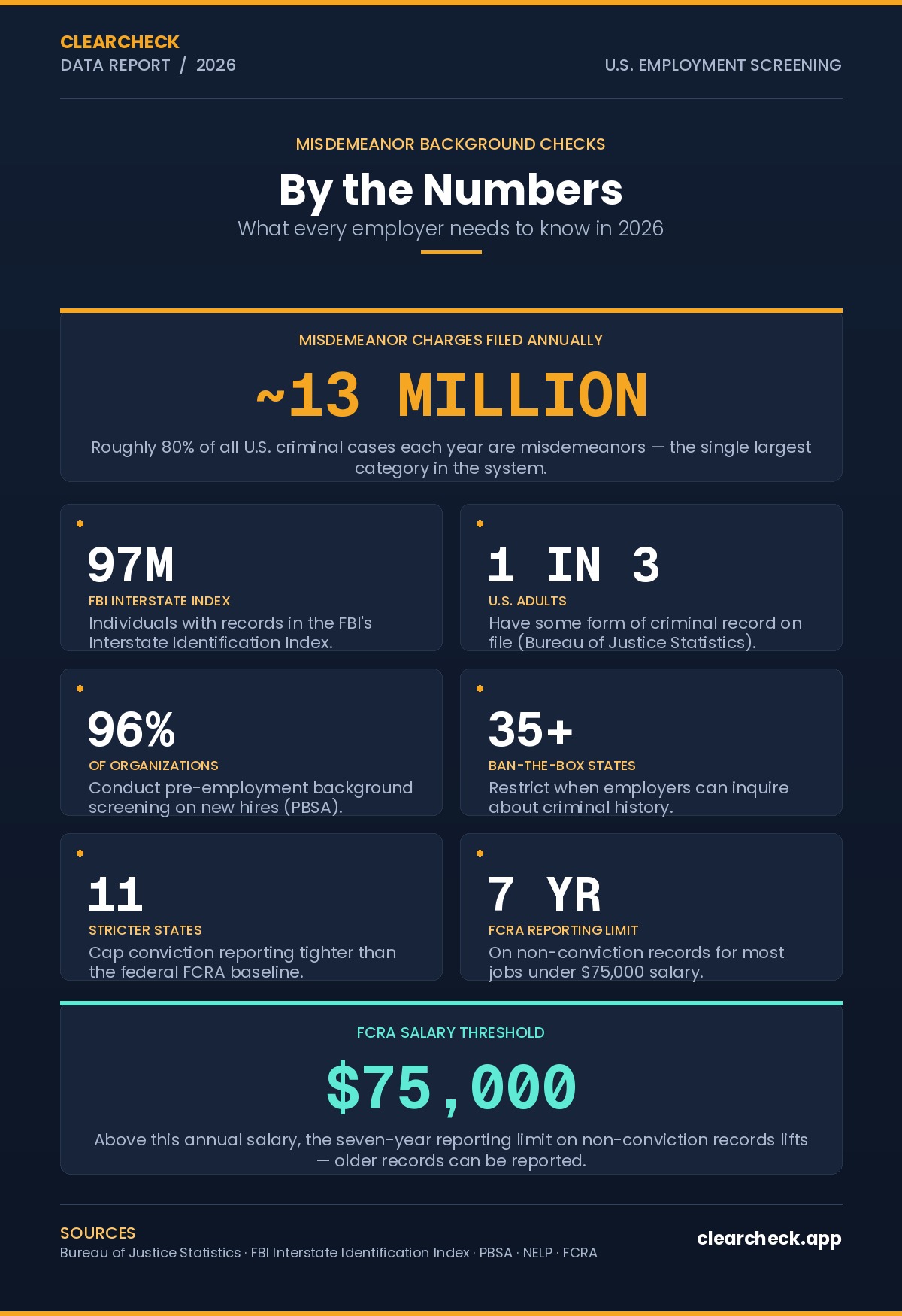
Here is the uncomfortable truth: misdemeanors comprise roughly 80 percent of all criminal cases in the United States — approximately 13 million misdemeanor charges are filed each year. That is not a small problem. That is a defining feature of the modern American hiring landscape.
So let’s answer the question directly. Do misdemeanors show up on background checks? And what does that actually mean for employers running screens — and for candidates whose past keeps following them into interview rooms?
This guide breaks it all down.
Do Misdemeanors Show Up on Background Checks? The Direct Answer
Let’s cut to the chase.
Yes — misdemeanors do show up on background checks in the vast majority of cases. A misdemeanor is still a criminal conviction. It still becomes part of someone’s permanent criminal record. And when an employer runs a properly conducted background check, that conviction will appear.
But here is where it gets interesting.
Whether a specific misdemeanor shows up depends on five key variables: the type of background check the employer runs, the jurisdiction where the offense occurred, how much time has passed since the conviction, the laws of the state where the search is being performed, and whether the record has been expunged or sealed.
In other words, the answer to “do misdemeanors show up on background checks?” is almost always yes — with caveats that matter enormously in practice.
Picture it this way: a misdemeanor on your record is like a stain on a white shirt. Under most lighting, anyone looking will see it. Under certain lighting (older convictions, sealed records, limited-scope searches), the stain might fade from view. But the stain itself does not vanish unless you actively work to remove it.
Here is what employers and candidates need to understand about every one of those variables.
What Counts as a Misdemeanor (And Why It Matters for Your Background Check)
Before we get into mechanics, here is something most people get wrong.
A misdemeanor is not the same as a traffic ticket. It is not the same as a civil infraction. And it is definitely not the same as a felony — though some misdemeanors are taken nearly as seriously by employers.
A misdemeanor is a criminal offense that may result in penalties such as fines, probation, community service, and short-term jail sentences, often limited to one year or less. The maximum punishment is generally a 12-month term of imprisonment, usually served in a county or local jail rather than state prison.
Common examples include:
- DUI/DWI (driving under the influence)
- Petty theft and shoplifting
- Simple assault (without a weapon or serious injury)
- Disorderly conduct
- Trespassing
- Vandalism under a certain dollar threshold
- Drug possession (small amounts, in some states)
- Reckless driving
The Three Classes of Misdemeanors
Now here is something most candidates don’t realize: not all misdemeanors are created equal.
Most states classify misdemeanors into three tiers, generally labeled Class A, Class B, and Class C (some states use numerals or alternate labels, but the concept is the same).
- Class A misdemeanors — the most serious. Examples: DUI with injury, simple assault, possession of certain controlled substances. Penalties up to one year in jail.
- Class B misdemeanors — mid-tier. Examples: shoplifting under a dollar threshold, certain drug paraphernalia charges, harassment. Penalties typically up to six months in jail.
- Class C misdemeanors — the least severe. Examples: disorderly conduct, public intoxication, minor traffic offenses elevated above infraction status. Penalties often limited to fines.
The class of misdemeanor matters because employers should pay attention to misdemeanor classes on a background check, as higher-class misdemeanors are generally considered more reasonable grounds for adverse hiring decisions.
A Class C disorderly conduct charge from a college football game eight years ago is going to land very differently from a recent Class A DUI conviction — even though both technically answer “yes” to the question of whether misdemeanors show up on background checks.
How Misdemeanors Show Up on Background Checks: The Four Search Types
Here is where most people get tripped up.
There is no such thing as “a background check.” There are many types of background checks — and each one pulls from different sources, with different coverage, different time frames, and different accuracy levels.
So when someone asks, “will my misdemeanor show up on a background check?” — the honest answer is: it depends on which one.
County-Level Criminal Searches
This is where the majority of misdemeanors actually live.
Why? Because misdemeanors are typically handled at the county or municipal court level, related records are often stored within local court systems. As a result, searches that include county-level court records in relevant locations are more likely to return misdemeanor offenses than searches that rely solely on statewide or national databases.
If an employer wants the highest-fidelity look at someone’s misdemeanor history, county-level searches in every jurisdiction the candidate has lived are the gold standard.
Statewide Criminal Searches
Statewide repositories aggregate criminal records reported up from county courts. They are broader in scope than a single county search, but they have a glaring weakness: not every county reports its data promptly, completely, or sometimes at all.
A recent misdemeanor from a small, slow-reporting county may not yet appear in a statewide search — even months after conviction.
National Criminal Database Searches
Here is the dirty secret of national database searches.
“National” sounds comprehensive. But these databases are aggregations of self-reported state data, and they are frequently incomplete, outdated, or missing entire jurisdictions. They are useful as a starting point — but treating them as definitive is how employers miss real records.
For deeper context on which search types are most reliable, see ClearCheck’s breakdown of what shows up on a background check.
Federal Criminal Searches
Federal criminal searches pull from federal court records. They are essential for surfacing federal crimes — but most misdemeanors are state-level offenses, not federal. So federal searches alone will not catch most misdemeanor history.
The bottom line? A properly designed background check layers all four search types. A bargain-basement search using only a single national database will almost certainly miss misdemeanor convictions that a layered search would catch in minutes.

How Long Do Misdemeanors Show Up on Background Checks?
This is the question that keeps job seekers up at night.
And the answer is more nuanced than most articles will admit. Let’s break it down properly.
The FCRA Seven-Year Rule (And Its Exceptions)
The Fair Credit Reporting Act (FCRA) is the federal law that governs what consumer reporting agencies — including background check providers — can include on a report.
Here is what FCRA actually says, and what it doesn’t say.
FCRA does limit reporting of non-conviction information (arrests that didn’t lead to a conviction, dismissed charges) to seven years for jobs paying less than $75,000 per year.
FCRA does not automatically limit reporting of actual convictions. As the FCRA rules do not apply to actual convictions, either. Without expungement, misdemeanors never go away. However, in some cases, background checks will only go back a few years.
In other words: the famous “seven-year rule” for convictions is a state-law phenomenon, not a federal one. Federal law lets convictions be reported indefinitely. State law is what often imposes the seven-year limit on convictions.
The $75,000 Salary Exception
Here is a wrinkle most candidates don’t know about.
For positions paying $75,000 or more annually, the seven-year FCRA limit on non-conviction reporting falls away. Convictions of any age can be reported. Some information that otherwise could not be reported can be reported if the candidate’s annual salary will equal (or could be reasonably expected to equal) $75,000 or more, which is known as Executive Exception.
For executive-level roles, deep historical criminal coverage is the legal norm.
State-by-State Variation in Misdemeanor Reporting
Now things really get interesting.
A handful of states have passed stricter rules than the FCRA baseline. These states restrict how far back consumer reporting agencies can report criminal convictions on employment background checks. Federal law (FCRA) allows indefinite reporting of convictions, but these states have stricter rules.
A quick state-by-state snapshot of conviction lookback limits:
- California: 7 years, all positions (Clean Slate Law also automatically seals most misdemeanors after 4 years)
- New York: 7 years for most positions
- Texas: 7 years for positions under $75,000; no limit above
- Massachusetts: Misdemeanors limited to 3 years; felonies to 7
- Washington: 7 years for all employment background checks
- Hawaii: Misdemeanors limited to 5 years
- New Hampshire: 7 years for annulled records cannot be reported
- Montana, Kentucky, Maryland: Various 7-year frameworks
For a deeper dive into lookback windows by state, see ClearCheck’s guide on how far back a background check goes.
When Misdemeanors Don’t Show Up on Background Checks
So we’ve established that misdemeanors usually appear. But there are real scenarios where they don’t.
Here are the most common.
The record has been expunged or sealed. Expungement is the legal process of having a conviction removed from public records. A properly expunged misdemeanor will not appear on most standard employment background checks. Misdemeanors are generally easier to expunge than felonies — but eligibility varies wildly by state and offense type.
The conviction is too old under state law. As covered above, several states block reporting of convictions older than a set number of years (typically seven).
The search wasn’t deep enough. If the employer ran a single national database search and skipped county-level checks, a misdemeanor from a slow-reporting county may simply not appear in the report. This is not the law working as intended — it is the search being incomplete.
The data hasn’t propagated yet. Recent convictions can take weeks or months to flow from county court systems to state and national databases. A misdemeanor from last month might not appear in a national database search today.
Civil infractions vs. misdemeanors. Some states have decriminalized certain offenses that were formerly misdemeanors — small-amount marijuana possession being the most common example. Civil infractions do not appear on criminal background checks.
This last point creates real confusion in cross-state hiring. Some jurisdictions may not classify misdemeanors similarly. In other words, a misdemeanor in one county or state might only be a civil infraction in another. Consider that possession of marijuana in some states is still a misdemeanor, while in areas where it has been “decriminalized,” it is the equivalent of getting a traffic ticket.

What the Research Actually Says About Misdemeanors and Employment Outcomes
Here is a finding that should reshape how every employer thinks about misdemeanor records.
A landmark 2024 study from researchers at Carnegie Mellon University’s Heinz College, in partnership with Rutgers, the University of Chicago, UC Berkeley, and Harvard Law School, looked at what happens when criminal records are removed from background checks under remediation policies like Clean Slate laws.
What they found was counterintuitive.
According to the Carnegie Mellon Heinz College study, removing existing criminal records — including misdemeanors — generally did not improve labor market outcomes for affected individuals. The damage to employment trajectories had already been done in the years immediately following the record’s creation.
“Criminal record remediation laws have been widely enacted to improve employment opportunities for millions of people,” said Andrew Garin, assistant professor of economics at Carnegie Mellon’s Heinz College and a co-author of the study. “But our findings suggest that records harm labor market trajectories in ways that are difficult to undo later.”
Why does this matter for employers?
Because it underscores that the way you evaluate misdemeanor records — at the time you encounter them — has outsized consequences. A blanket disqualification policy doesn’t just affect the candidate in front of you. It contributes to a cumulative employment scarring effect that lasts years.
This is why the EEOC and most modern compliance frameworks require individualized assessment, not blanket exclusion.
Visual Data Report: Misdemeanors on Background Checks in 2026
Here is a snapshot of where misdemeanor background check screening sits in the current hiring landscape.
What Employers Should Know About Misdemeanor Background Checks
Here is the part most hiring managers skip — and then regret.
Just because a misdemeanor shows up doesn’t mean you can act on it however you want. There is a legal framework, and ignoring it is how negligent-hiring lawsuits and EEOC complaints get filed.
The EEOC’s Individualized Assessment Requirement
Federal anti-discrimination law requires employers to conduct an individualized assessment when criminal history is a factor in a hiring decision. That means considering:
- The nature and gravity of the offense — a misdemeanor shoplifting charge is more relevant to a retail cashier role than a remote software engineering role
- The time elapsed since the offense — a 15-year-old misdemeanor carries different weight than one from last quarter
- The nature of the job — the level of trust, access to sensitive information, and potential for harm
Blanket policies that disqualify any candidate with any misdemeanor are legally risky — particularly when those policies have a disparate impact on protected classes.
Ban the Box and Fair Chance Laws
More than 35 states and 150+ municipalities have enacted Ban the Box legislation. These laws restrict when during the hiring process an employer can ask about — or run a background check that includes — criminal history.
In most jurisdictions, employers must wait until after extending a conditional offer of employment before conducting the check. Asking too early is a compliance violation.
Adverse Action Procedures
Under FCRA, if you decide not to hire someone based on a misdemeanor that shows up on their background check, you must:
- Send a pre-adverse action notice including a copy of the report and a copy of the candidate’s rights
- Give the candidate reasonable time to dispute the findings (typically five to seven business days)
- Send a final adverse action notice if you proceed with the decision
For an end-to-end overview of how this fits into a compliant program, see ClearCheck’s felony background check guide — most of the framework applies identically to misdemeanors.
Running a Background Check That Actually Surfaces Misdemeanors
Here is the practical part.
If you are an employer and you want a background check that reliably surfaces misdemeanor convictions — not one that misses half of them — you need a layered approach.
Step 1: Run County-Level Searches in Every Relevant Jurisdiction
Pull county court records from every county where the candidate has lived or worked over the past seven years. This is where most misdemeanor convictions actually live.
Step 2: Add Statewide and National Coverage
Layer statewide repository searches on top of the county data, plus a national criminal database search to catch records the candidate didn’t disclose from jurisdictions you didn’t know to search.
Step 3: Verify Identity Correctly
A surprising number of background check failures aren’t about missing data — they are about misattributed data. Make sure your provider verifies the candidate’s SSN and matches records against full identifying information, not just name and date of birth.
Step 4: Use a Provider Built for Compliance
This is where ClearCheck comes in. Every workflow on the platform is FCRA compliant — from disclosure and authorization through adverse action documentation. Most checks return results in 30 seconds or less, with searches that include nationwide criminal history, statewide seven-year records, sex offender registry, and SSN verification.
For a comparison of how ClearCheck stacks up against alternatives, see the recent breakdown of the best criminal background check sites for employers in 2026.
Frequently Asked Questions About Misdemeanors on Background Checks
Do misdemeanors show up on background checks after 7 years?
In most states, yes. The federal FCRA does not limit reporting of convictions to seven years. Some states (California, New York, Washington, and others) impose their own seven-year limits on conviction reporting, but unless your state has that rule, an unexpunged misdemeanor conviction can appear indefinitely.
Does a misdemeanor show up on a federal background check?
A federal background check pulls federal court records, which means most state-level misdemeanors will not appear unless the offense was prosecuted federally. A comprehensive employment background check typically combines federal, state, and county searches to catch all relevant records.
Will a misdemeanor DUI show up on a background check?
Yes. A misdemeanor DUI conviction will appear on most criminal background checks. It may also show up on motor vehicle record (MVR) checks, which are commonly run for driving-related positions.
Can I get a job with a misdemeanor on my background check?
In most cases, yes. A common concern is: can I pass a background check with a misdemeanor? The good news is, many people do. It depends on the employer’s policy and how long ago the misdemeanor occurred. EEOC guidance requires employers to evaluate the relevance of the offense to the role — not to disqualify based on conviction alone.
Does an expunged misdemeanor show up on a background check?
Generally, no. A properly expunged misdemeanor should not appear on standard employment background checks. However, some government and licensing-related checks (federal security clearance, certain healthcare and education roles) may still access expunged records under specific exceptions.
How do I know if a misdemeanor will show up on my background check?
The best way to know is to run a check on yourself before applying. ClearCheck’s self-check workflow uses the same data sources employers use — so you see exactly what they will see.
The Bottom Line on Misdemeanors and Background Checks
Here is the honest summary.
Do misdemeanors show up on background checks? In the vast majority of cases, yes. They are part of a permanent criminal record. They appear on county searches, on statewide databases, and on layered national searches — for years after the conviction, and in many states, indefinitely.
For employers, the question is not whether to look for misdemeanors. It is whether your screening process is thorough enough to actually find them — and structured enough to evaluate them fairly when you do.
For candidates, the question is not whether your misdemeanor will appear. It is whether you can address it honestly, demonstrate growth since the offense, and find employers who evaluate the whole person rather than the worst data point.
ClearCheck was built for both sides of that equation. Fast, FCRA-compliant background checks that surface every relevant misdemeanor, structured to give employers the information they need and candidates the due process they deserve.
Run a Misdemeanor Background Check in 30 Seconds — Starting at $19.99
Every day you delay is a day you’re hiring blind.
One undisclosed misdemeanor on a single hire can cost your business thousands in liability, turnover, and reputational damage. ClearCheck delivers complete misdemeanor and felony background checks in 30 seconds or less — fully FCRA-compliant, court-record verified, with no contracts and no setup fees.
The line cook in Atlanta wishes someone had explained this to him before that interview.
You can be the employer who knows. Or you can be the next negligent-hiring lawsuit.
Limited-time pricing on all four tier packages. Set up your account and run your first check in under five minutes.