Here’s something that sounds impossible but happens every single day.
A case gets dismissed. No conviction. No guilty plea. No finding of wrongdoing. The judge throws it out. Legally, the person walks away presumed innocent — because they are innocent in the eyes of the law.
And then, months later, that dismissed charge costs them a job.
How? Because the background check showed the charge — but not the dismissal. The employer saw “felony theft, filed” with no disposition listed, assumed the worst, and quietly moved on to the next candidate. The applicant never even knew why.
This is the cruel paradox of dismissed charges. A dismissal is supposed to be a clean ending. But on a poorly run background check, a dismissed charge can do almost as much damage as a conviction — not because of what happened in court, but because of what the report failed to say.
So let’s settle the question once and for all. Do dismissed charges show up on a background check? And if they do, what can you actually do about it?
This guide breaks it down.
Do Dismissed Charges Show Up on a Background Check? The Direct Answer
Let’s not dance around it.
Yes — dismissed charges can and often do show up on a background check. Despite the fact that a dismissal is not a conviction, most standard criminal background checks will report dismissed charges, because the charge itself is part of the public court record.
Here’s the distinction that surprises people: a background check doesn’t just report convictions. It reports criminal history — and that includes arrests, filed charges, and case dispositions, whether those dispositions were guilty, not guilty, or dismissed.
So when a screening company pulls a candidate’s county court records, the dismissed case is right there in the file. Unless it’s been sealed or expunged, or unless it falls outside the legal reporting window, it can appear on the report.
But — and this is the good news — dismissed charges are treated very differently from convictions under federal law. They’re classified as non-conviction records, and that classification triggers a powerful set of protections.
Think of it this way: a conviction is a permanent scar. A dismissed charge is more like a bruise — it shows for a while, it fades on a legal timeline, and with the right action, you can often make it disappear entirely.
Here’s exactly how that works.
Dismissed vs. Dropped vs. Acquitted: Why the Words Matter
Before we go further, we need to untangle some terms people use interchangeably — because each one means something slightly different on a background check.
Dismissed Charges
A dismissed charge means the court terminated the case without a conviction. This can happen for many reasons: insufficient evidence, a procedural error, completion of a diversion program, or a prosecutor’s decision. The key fact: there’s no finding of guilt.
Dropped Charges
“Dropped” charges typically refers to charges the prosecutor declines to pursue — often before the case ever gets to trial. Functionally similar to a dismissal in that there’s no conviction, but the timing and mechanism differ.
Acquittals
An acquittal means the case went to trial and the defendant was found not guilty. This is the strongest form of non-conviction — an affirmative finding of innocence by a judge or jury.
Here’s what all three have in common: under the Fair Credit Reporting Act, they are all non-conviction records — and they’re all subject to the same reporting limits, which is where things get interesting.
For a broader look at how various record types behave on a screen, see ClearCheck’s what shows up on a background check guide.
How Long Do Dismissed Charges Show Up on a Background Check?
This is the question that matters most — and the answer is more favorable than most people expect.
The FCRA Seven-Year Rule for Non-Convictions
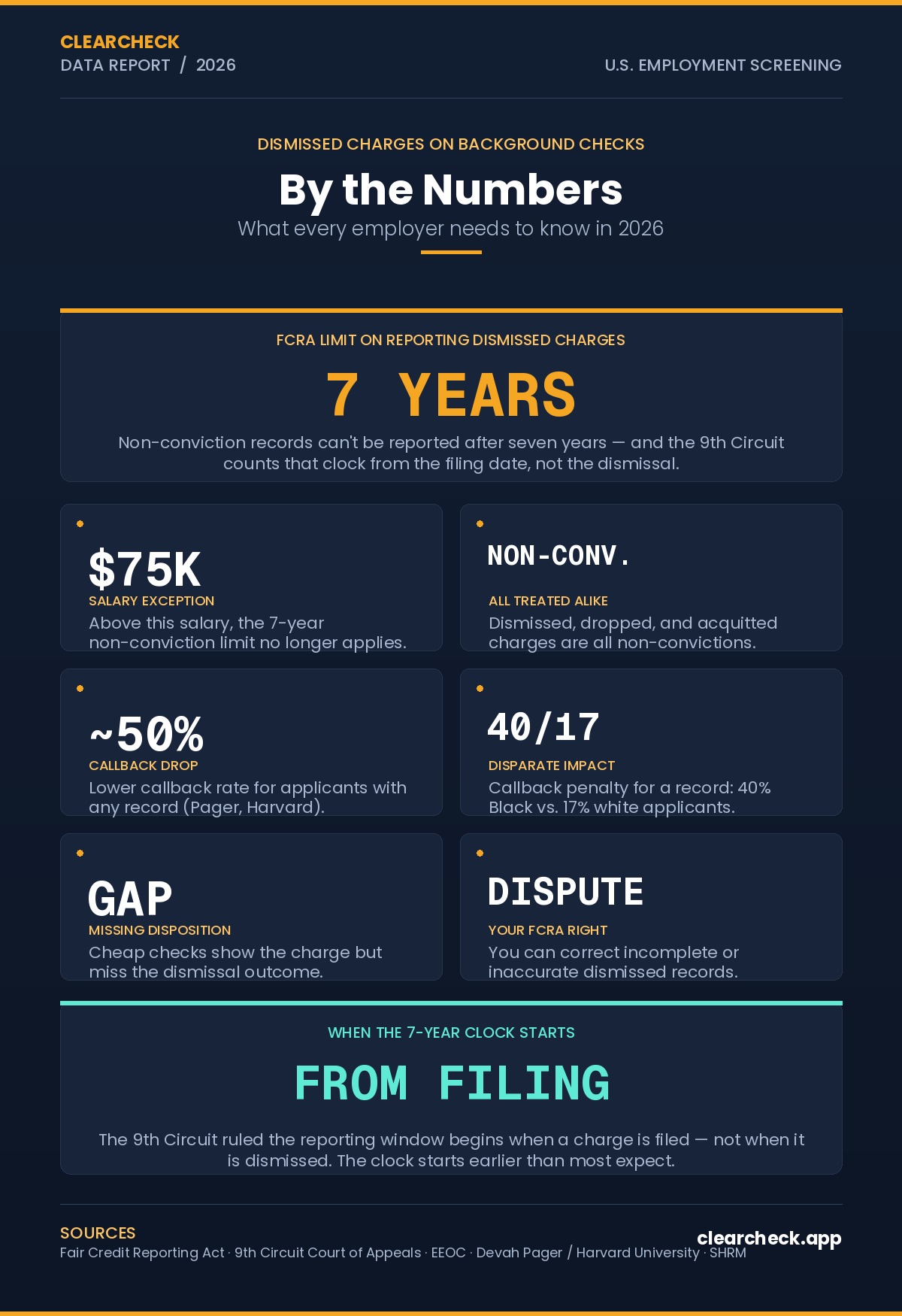
Under the Fair Credit Reporting Act (FCRA), consumer reporting agencies generally cannot report non-conviction records — including dismissed, dropped, and acquitted charges — that are older than seven years.
This is the opposite of how convictions work. A conviction can be reported indefinitely under federal law. But a dismissed charge? It falls off after seven years. The dismissal’s status as a non-conviction is exactly what gives you this protection.
The $75,000 Salary Exception
Here’s a wrinkle worth knowing.
The seven-year limit on non-conviction reporting falls away for positions paying $75,000 or more annually. For high-salary roles, even older dismissed charges can legally be reported. This is sometimes called the “executive exception,” and it catches a lot of senior candidates by surprise.
When the Clock Actually Starts: A Critical Court Ruling
Here’s a detail that almost nobody knows — and it can make a real difference.
In a significant ruling, the 9th U.S. Circuit Court of Appeals held that the seven-year reporting window for a criminal charge begins when the charge is filed, not when it’s dismissed. The measuring period runs from the date of entry, not the date of disposition.
Why does this matter? Because under this interpretation, the clock starts earlier than many people assume. If you were charged in January 2017 and the case was dismissed in December 2018, the seven-year window runs from 2017 — meaning the charge should drop off in 2024, not 2025. The 9th Circuit covers Alaska, Arizona, California, Hawaii, Idaho, Montana, Nevada, Oregon, and Washington.
For more on how lookback windows work across different record types, see ClearCheck’s how far back a background check goes guide.

The Real Danger: Missing Disposition Data
Here’s where dismissed charges cause the most damage — and it’s not what most people think.
The biggest problem with dismissed charges on background checks isn’t that they appear. It’s that they appear without the dismissal noted.
Why Incomplete Records Are So Harmful
When a background check report shows a charge but fails to show the final “dismissed” disposition, it can have the same damaging effect as a conviction. An employer who sees an open charge with no resolution may assume the case is still pending — or worse, assume the candidate was guilty.
This happens constantly with cheap, database-driven background checks. The data broker scraped the arrest or the filing, but never captured the court’s final disposition. The result: a report that makes a dismissed case look like an unresolved one.
The Accuracy Requirement Under FCRA
This is precisely why FCRA-compliant background checks require disposition verification.
An FCRA-compliant background check requires much more than running a name through a national database. Records must be verified at the original source — the county courthouse — before they’re included in a report. A proper report doesn’t just say “charge filed”; it says “charge filed, dismissed on [date].”
This is the single biggest differentiator between a quality screening provider and a bargain-basement one. For a comparison of reliable providers versus database scrapers, see the best criminal background check sites for employers in 2026.
What Candidates Can Do About Incomplete Records
If a dismissed charge shows up without its disposition, you have the right under FCRA to dispute it. The consumer reporting agency must reinvestigate and correct inaccurate or incomplete information. Providing a copy of the court’s dismissal order is usually the fastest path to correction.
What the Research Says About Dismissed Charges and Hiring
Here’s a finding from the academic literature that should make every employer think twice before acting on a dismissed charge.
The landmark study on criminal records and hiring comes from sociologist Devah Pager, whose research at Harvard and Princeton produced The Mark of a Criminal Record, published in the American Journal of Sociology. Pager’s field experiments produced two findings that are directly relevant here.
First, a criminal record — even a minor one — dramatically reduces the likelihood of a callback. Applicants with a record were roughly half as likely to hear back from employers as identical applicants without one.
Second, and more troubling: the effect was racially skewed. The research found that having a criminal record reduced callback rates by about 40% for Black applicants compared to roughly 17% for white applicants. In one striking result, white applicants with a criminal record received more callbacks than Black applicants without one.
Why does this matter for dismissed charges specifically?
Because a dismissed charge is not proof of anything. As the EEOC has repeatedly emphasized, arrests and dismissed charges are not evidence of criminal conduct — the person was never convicted. When employers treat a dismissed charge like a conviction, they’re not just being unfair; they’re creating disparate-impact liability under Title VII, given the documented racial skew in how criminal records affect hiring outcomes.
The takeaway: a dismissed charge demands context and caution, not a reflexive rejection.
Visual Data Report: Dismissed Charges on Background Checks in 2026
Here is a snapshot of the dismissed-charges screening landscape.
What Employers Should Know About Dismissed Charges on Background Checks
Here’s where compliance gets real.
A dismissed charge that surfaces on a screen is one of the highest-risk items an employer can mishandle. Get it wrong, and you’re looking at EEOC complaints, FCRA violations, and disparate-impact lawsuits. Here’s how to handle it correctly.
Arrests and Dismissals Are Not Proof of Conduct
The EEOC’s position is unambiguous: because arrest records and dismissed charges don’t establish that any criminal conduct actually occurred, employers generally may not rely on them alone to exclude a candidate. Many arrests never result in charges, and many charges are dismissed. Treating a dismissal as if it were a conviction is both unfair and legally dangerous.
Many States Restrict Using Dismissed Charges
A number of states prohibit employers from asking about or considering dismissed charges, arrests that didn’t lead to conviction, or non-conviction records entirely. Ban the Box laws in 35+ states further restrict when and how criminal history can enter the hiring conversation. Before acting on a dismissed charge, employers need to know their specific state and local rules.
Follow FCRA Adverse Action Procedures
If a dismissed charge influences a hiring decision — even a charge you’re legally allowed to consider — the FCRA adverse action process applies: pre-adverse action notice with a copy of the report, reasonable time to dispute, then a final adverse action notice. The dispute window is critical here, because it gives candidates the chance to provide a dismissal order that corrects an incomplete record.
For the full framework on evaluating any concerning record without creating liability, ClearCheck’s felony background check guide covers the EEOC individualized-assessment standard.
How to Remove or Address Dismissed Charges on a Background Check
Here’s the practical part — what you can actually do about a dismissed charge.
Step 1: Run a Background Check on Yourself First
Before you apply for jobs, see what employers will see. A self-check reveals whether a dismissed charge is appearing — and critically, whether the dismissal disposition is showing correctly. This is the single most important step, because it lets you fix problems before they cost you a job.
Step 2: Petition to Seal or Expunge the Record
A dismissed charge is often an excellent candidate for sealing or expungement, since there was no conviction. Once sealed or expunged, the charge should not appear on standard background checks at all — even within the seven-year window. Provide the screening agency with a copy of the sealing or expungement order.
Step 3: Dispute Incomplete or Outdated Records
If a dismissed charge appears without its disposition, or appears after the seven-year window has closed, you have the right under FCRA to dispute it. The consumer reporting agency must reinvestigate. If they continue reporting a record after you’ve notified them it was expunged or sealed, they may be liable for damages.
Step 4: Use an Accurate, Compliant Screening Provider
The root cause of most dismissed-charge problems is bad data from cheap, database-only checks. ClearCheck pulls from current, authoritative court records and runs FCRA-compliant searches that capture full disposition data — returning results in 30 seconds or less. For candidates, that means an accurate picture. For employers, it means a defensible, compliant screen.
Frequently Asked Questions About Dismissed Charges and Background Checks
Do dismissed charges show up on a background check after 7 years?
Generally, no. Under the FCRA, dismissed charges and other non-conviction records can’t be reported after seven years. The 9th Circuit has ruled that this seven-year clock begins when the charge was filed, not when it was dismissed. The exception is for jobs paying $75,000 or more, where the limit doesn’t apply.
Why does a dismissed charge still show on my background check?
Because the charge is part of the public court record. Unless it’s been sealed or expunged, or it falls outside the seven-year window, a dismissed charge can legally appear. The bigger problem is often that the report shows the charge but not the dismissal — which you can dispute and correct.
Can an employer reject me for a dismissed charge?
It depends on the state, the role, and how the charge is handled. The EEOC cautions that dismissed charges and arrests aren’t proof of criminal conduct, and many states prohibit using them in hiring decisions entirely. Employers who reject candidates based solely on dismissed charges risk disparate-impact liability.
What’s the difference between dismissed and expunged on a background check?
A dismissed charge means the case ended without a conviction, but the record of the charge still exists and can appear for up to seven years. An expunged charge has been legally erased or sealed and should not appear on standard background checks at all. Getting a dismissed charge expunged is often the most reliable way to remove it.
Do dismissed charges show up on an FBI background check?
FBI fingerprint-based checks pull from federal databases (NCIC and III) that may include arrest and charge data regardless of disposition. These checks, used for certain regulated jobs, can surface dismissed charges that wouldn’t appear on a standard private-employer check. Sealing or expungement is the most reliable protection.
How do I get a dismissed charge removed from my background check?
The most reliable method is to petition the court to seal or expunge the record, then provide the order to screening agencies. You can also dispute incomplete records (a charge shown without its dismissal) or outdated records (older than seven years) under the FCRA, which requires the agency to reinvestigate and correct.
Will a dismissed charge affect a security clearance or government job?
Possibly. Government background investigations and security clearance reviews look beyond the standard seven-year window and consider the full picture, including dismissed charges. A dismissal isn’t automatically disqualifying, but it may prompt deeper review of the underlying circumstances.
The Bottom Line on Dismissed Charges and Background Checks
Here’s the honest summary.
Do dismissed charges show up on a background check? Often, yes — because the charge is part of the public court record. But dismissed charges are non-conviction records, which means they’re subject to the FCRA’s seven-year reporting limit (measured from the filing date in the 9th Circuit), they can usually be sealed or expunged, and they cannot lawfully be treated like convictions by employers.
The real danger isn’t that a dismissed charge appears. It’s that it appears without the dismissal noted — making a clean outcome look like an unresolved case. That’s a data-quality problem, and it’s fixable.
For candidates, the lesson is clear: check your own record, fix incomplete data, and pursue sealing or expungement where you can.
For employers, the lesson is equally clear: a dismissed charge is not a conviction, treating it like one creates real liability, and the only safe foundation is a screen built on accurate, current, disposition-verified court records.
ClearCheck was built for exactly that. Fast, FCRA-compliant background checks that capture full disposition data from authoritative sources — protecting candidates’ rights and employers’ compliance at the same time.
Run an Accurate, Disposition-Verified Background Check — Starting at $19.99
A background check that shows a charge but misses the dismissal isn’t just inaccurate — it’s a lawsuit waiting to happen.
Cheap database-scraper checks routinely report dismissed charges as if they were unresolved or guilty outcomes, exposing your business to FCRA and EEOC liability. ClearCheck pulls from current, authoritative court records with full disposition data, runs fully FCRA-compliant searches, and returns results in 30 seconds — starting at $19.99 per check. No contracts. No setup fees.
Stop gambling your hiring decisions on incomplete data. See the full, accurate picture — every charge, every disposition, every time.
Limited-time launch pricing on all four tier packages. Set up your account and run your first check in under five minutes.