Think of a background check like a medical panel — the kind your doctor orders when they need a complete picture of your health. A single blood test doesn’t tell the whole story. It’s the combination of tests — cholesterol, glucose, liver function, thyroid — that gives the doctor enough data to make an informed decision.
A background check works the same way.
It’s not one search. It’s a structured package of individual searches, each querying different databases, contacting different sources, and answering different questions about the person being screened. The specific combination depends on the purpose (employment, tenancy, volunteering), the industry (healthcare, finance, transportation), and the level of risk associated with the role.
Yet most people — employers and candidates alike — treat “background check” as a single, monolithic thing. They don’t know what it actually consists of, what databases are queried, or why certain components are included while others aren’t.
That gap creates problems. Employers order packages that are either too shallow (missing critical checks for the role) or too broad (paying for searches they don’t need and slowing down turnaround). Candidates worry about the wrong things because they don’t understand the scope.
According to the Professional Background Screening Association (PBSA) and HR.com, 94% of employers conduct some form of background screening. But understanding what that screening actually consists of? That’s where most people need help.
Let’s open the black box.
What Does a Background Check Consist Of? The Building Blocks
Every background check is assembled from individual components — each one an independent search with its own data sources, turnaround time, and legal requirements. Here’s what each building block consists of, mechanically.
Identity Verification and SSN Trace
What it is: The foundation of every screening package. This search confirms that the person being screened is who they claim to be.
What databases it queries: Credit bureau header files (Equifax, Experian, TransUnion), address databases, and Social Security Administration records.
What it produces: Confirmation that the SSN is valid and matches the candidate, a list of names and aliases associated with that SSN, current and previous addresses, and a deceased status indicator.
Why it matters: The SSN trace generates the address history that tells the screening provider where to search for criminal, civil, and court records. Without it, the provider wouldn’t know which counties and states to query. Think of it as the GPS coordinates for every other search in the package.
Turnaround: Instant — typically under 90 seconds.
Criminal Record Searches
This is the component most people think of when they hear “background check.” But a criminal search isn’t one search — it’s typically three to five concurrent searches across different court systems.
National Criminal Database Search
What it queries: Aggregated databases containing hundreds of millions of records from correctional systems, sex offender registries, terrorist watch lists, and state criminal repositories across all 50 states.
What it produces: Potential hits that need to be verified at the original court source. National databases are broad but not always current — they’re a starting point, not a final answer.
Turnaround: Instant to a few hours.
County Criminal Court Search
What it queries: The original court records at the county courthouse where the individual has lived. This is the gold standard for criminal record accuracy because it goes directly to the source.
What it produces: Felony and misdemeanor convictions, pending charges, case dispositions, and sentencing information — all verified at the court level.
Why it’s critical: National databases aggregate records from many sources, but they can contain outdated or incomplete information. County-level searches provide the most current, verified data. ClearCheck’s guide to criminal background checks in North Carolina shows how state and county-level searches work in practice.
Turnaround: One to five business days, depending on whether the court offers digital access or requires manual retrieval.
State Criminal Repository Search
What it queries: Centralized state-level criminal databases maintained by state law enforcement agencies (e.g., State Bureau of Investigation).
What it produces: Statewide criminal records — useful for catching records in counties where the candidate has lived but that weren’t identified through address history.
Turnaround: One to three business days.
Federal Criminal Court Search
What it queries: The U.S. federal court system (PACER) across all 94 federal judicial districts.
What it produces: Federal crimes including white-collar offenses, drug trafficking, fraud, embezzlement, and immigration violations.
Turnaround: One to two business days.
Employment Verification
What it is: A direct confirmation that the candidate actually held the jobs they claim on their resume.
What sources it contacts: Former employer HR departments, automated verification systems (The Work Number by Equifax, Thomas & Company), payroll processors, and staffing agencies.
What it produces: Confirmed job titles, dates of employment, salary information (if disclosed), and reason for departure (if the employer provides it).
The challenge: Employment verification is the most variable component in any screening package. Large corporations with centralized HR and automated systems respond in hours. Small businesses without dedicated HR staff may take days — or never respond at all. Candidates who worked through staffing agencies or subcontractors create additional complexity because the actual employer of record may differ from where they physically worked.
According to a HireRight benchmark report, approximately 85% of employers have caught applicants misrepresenting information on their resumes — which is exactly why this component exists, even when it’s the slowest part of the package.
Turnaround: Two to five business days.
Education Verification
What it is: Confirmation that the candidate earned the degrees and certifications they claim.
What sources it contacts: The National Student Clearinghouse (which compiles records from thousands of institutions), university registrar offices, and international credential evaluation services for foreign degrees.
What it produces: Institutions attended, dates of attendance, degrees or certifications earned, and fields of study.
Why it matters: Research from the Georgetown University Center on Education and the Workforce has documented persistent credential misrepresentation across industries, particularly at mid-management and executive levels. The Des Moines superintendent case from 2025 — where a background check flagged an incomplete doctorate but the school board hired anyway — remains a cautionary example.
Turnaround: Minutes (if in the Clearinghouse) to five business days (if manual outreach is required).
Credit Report
What it is: A modified consumer credit report showing the candidate’s financial history. Note: employers receive a different report than what consumers see — it does not include the actual credit score.
What sources it queries: The three major credit bureaus — Equifax, Experian, and TransUnion.
What it produces: Outstanding debts, accounts in collections, bankruptcies, tax liens, payment history patterns, and recent credit inquiries.
When it’s used: Primarily for roles involving financial responsibility — banking, accounting, executive positions, and roles with access to company funds or sensitive financial data. Several states restrict or prohibit credit checks for employment unless the role directly involves financial duties.
Turnaround: Instant to a few hours.
For a full breakdown of what each screening type reveals, see ClearCheck’s companion guide on what a background check shows.
Drug Screening
What it consists of: A laboratory-based test for controlled substances, processed through a SAMHSA-certified lab with Medical Review Officer (MRO) oversight.
The process: The candidate provides a specimen at a designated collection site. The sample is tested using immunoassay screening; presumptive positives undergo confirmatory testing via gas chromatography–mass spectrometry (GC-MS). If the confirmation test is positive, an MRO reviews the results and contacts the candidate to determine whether a valid prescription explains the finding.
Standard panels: A 5-panel test covers marijuana, cocaine, opiates, amphetamines, and PCP. A 10-panel adds benzodiazepines, barbiturates, methadone, propoxyphene, and methaqualone. Expanded panels exist for safety-sensitive or DOT-regulated roles.
Turnaround: One to three business days for negative results. Confirmed positives with MRO review may take two to five days.
Motor Vehicle Records (MVR)
What sources it queries: State Department of Motor Vehicles (DMV) databases.
What it produces: Traffic violations, DUI/DWI convictions, license suspensions or revocations, accident history, license class and endorsements.
When it’s used: Any role involving driving — delivery, trucking, field sales, company vehicle use. DOT-regulated positions require additional checks through the Drug and Alcohol Clearinghouse.
Turnaround: Minutes to one business day.
Professional License Verification
What sources it queries: State licensing boards, national certification databases, and exclusion lists (OIG, GSA, state Medicaid).
What it produces: License type, number, issuing authority, current status (active/expired/suspended/revoked), and any disciplinary actions on record.
When it’s used: Healthcare, legal, accounting, teaching, real estate, engineering — any role requiring a professional credential.
Turnaround: One to five business days.
Social Media Screening
What it consists of: An AI-assisted scan of publicly available social media profiles across platforms like LinkedIn, Facebook, Instagram, X, TikTok, and Reddit.
What it flags: Posts involving threats, violence, harassment, hate speech, illegal activity, and discriminatory behavior. Responsible providers filter out protected class information (race, religion, disability, familial status) to prevent bias.
Turnaround: One to three business days.
How Screening Packages Are Assembled
No one orders every component for every candidate. Screening packages are built around three variables: the role level, the industry, and the regulatory requirements.
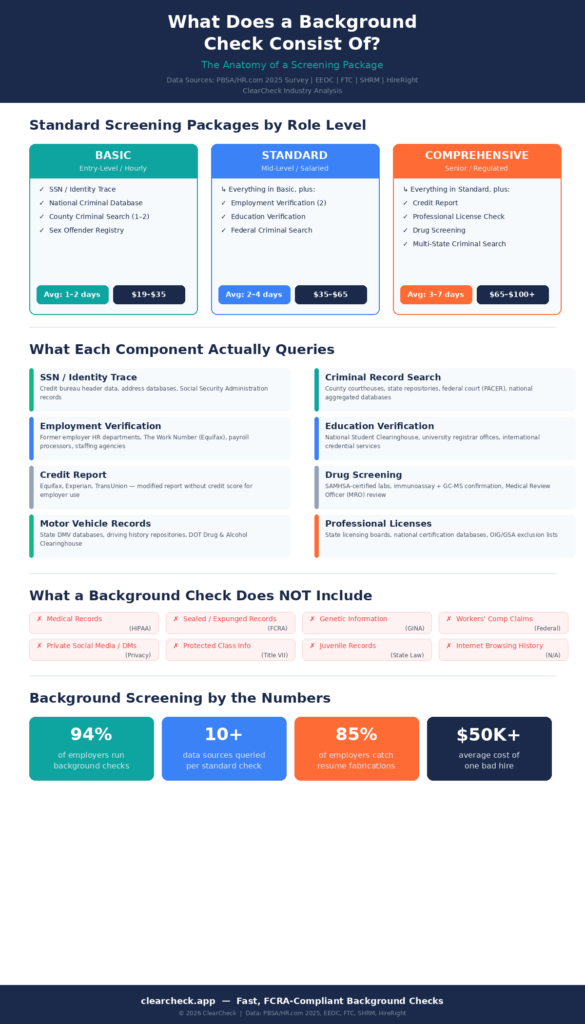
Basic packages (entry-level, hourly, low-security roles) typically consist of identity verification, a national criminal database search, one to two county criminal searches, and a sex offender registry check. These packages return in one to two business days and cost the least.
Standard packages (mid-level salaried positions) add employment verification, education verification, and a federal criminal search. Turnaround averages two to four business days.
Comprehensive packages (senior leadership, regulated industries, financial roles) include everything in the standard tier plus credit reports, professional license verification, drug screening, and multi-state criminal searches. These take three to seven business days but provide the deepest level of vetting.
The right package matches the risk profile of the role — not the other way around. A cashier doesn’t need a credit check. A CFO doesn’t need just a basic criminal search. ClearCheck’s guide to background screening solutions helps employers build the right package for every role.

What a Background Check Does NOT Consist Of
Understanding the boundaries is just as important as understanding the components. Here’s what is explicitly excluded from compliant screening packages:
Medical records — protected by HIPAA, completely off-limits.
Sealed or expunged records — FCRA-compliant providers automatically exclude records that courts have ordered sealed or expunged. In 2026, Clean Slate laws in Virginia, Pennsylvania, and Washington D.C. are expanding the pool of automatically sealed records.
Genetic information — protected under the Genetic Information Nondiscrimination Act (GINA).
Workers’ compensation claims — cannot be used in pre-employment decisions.
Private social media content — only publicly available information can be reviewed.
Protected class information — race, religion, national origin, disability, familial status, and gender identity cannot legally be included in a screening report or used in hiring decisions.
The FCRA (15 U.S.C. § 1681) governs every component of every employment background check. Violations — including reporting non-reportable records — carry penalties that regularly reach six- and seven-figure settlements in class actions.
The Compliance Layer: What Holds It All Together
Every component of a background check is wrapped in a compliance framework governed by the FCRA. This isn’t optional infrastructure — it’s the legal skeleton that makes the entire process defensible.
Disclosure and consent: Before any search runs, the candidate must receive a standalone written notice and sign an authorization. This applies to every component, every time.
Accuracy requirements: The screening provider (acting as a Consumer Reporting Agency) must follow reasonable procedures to ensure maximum possible accuracy. Reporting duplicate records, expunged records, or records belonging to the wrong person violates the FCRA.
Adverse action process: If any component produces information that leads to a negative hiring decision, the employer must follow the two-step adverse action process — pre-adverse notice with a copy of the report, a dispute period, and a final adverse action notice.
Dispute rights: The candidate has the right to dispute any inaccuracy in the report, and the screening provider must investigate and resolve the dispute within 30 days.
For a full understanding of what these processes cost, see how much does a background check cost.

The Bottom Line: Know Exactly What You’re Ordering
What does a background check consist of? Not one search, but many — each targeting a different database, contacting a different source, and answering a different question. The right combination depends on the role, the industry, and the regulatory requirements. The wrong combination either leaves gaps that create risk or includes unnecessary searches that waste time and money.
With ClearCheck, you don’t have to guess. Build the right package for every role, get results in hours instead of days, and know that every component meets FCRA compliance standards — automatically.
Build the Right Screening Package for Every Role — Start with ClearCheck
A one-size-fits-all background check doesn’t exist. Your screening package shouldn’t either. ClearCheck lets you build customized, FCRA-compliant screening packages starting at $19.99 — results in hours, no contracts, no setup fees.
Your next hire deserves the right level of vetting. Your organization deserves the right level of protection. Both start here.