
A landlord in suburban Atlanta learned this the expensive way. She rented a three-bedroom townhome to a couple who charmed her during the walkthrough — polished, professional, great first impression. They paid the deposit upfront. They signed the lease on the spot. She skipped the background check because, in her words, “they just seemed like good people.”
Four months later, they stopped paying rent. By month six, the unit had $14,000 in damage, two neighbors had filed noise complaints, and she was staring down a formal eviction process that would eventually cost her more than $30,000 in legal fees, lost rent, and repairs.
Here’s the part that stings:
A single tenant background check — one that takes minutes and costs less than a dinner for two — would have revealed prior evictions, an active collections balance, and a pattern of lease violations from two previous landlords.
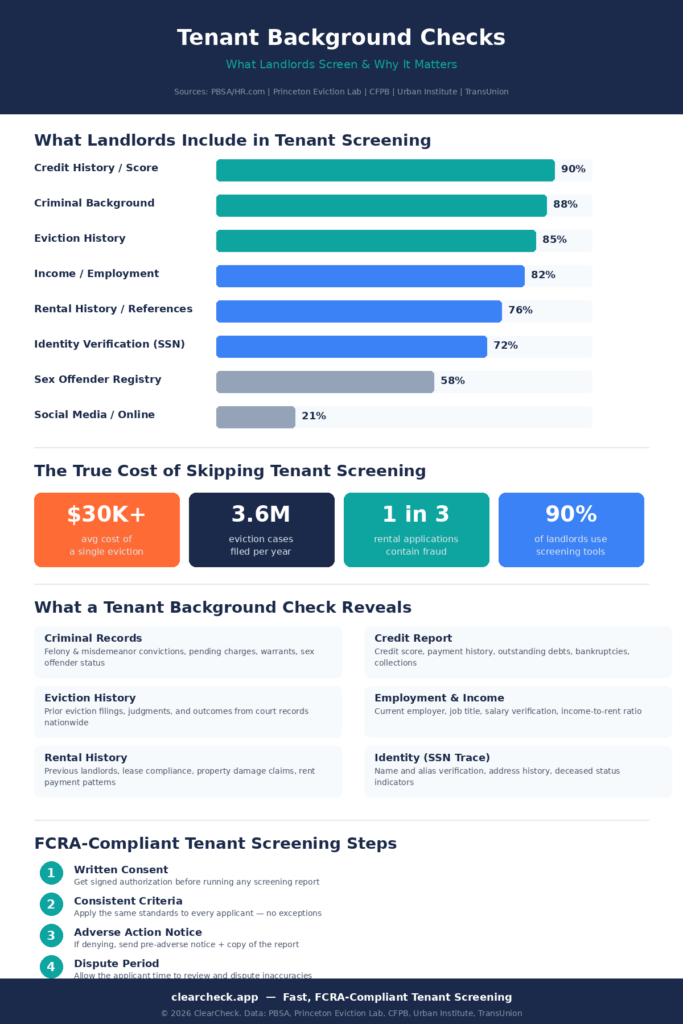
This story isn’t unusual. According to the Princeton University Eviction Lab, 3.6 million eviction cases are filed in the United States every year. Industry data suggests nearly one in three rental applications contain some form of fraudulent or misleading information. And yet, many independent landlords still skip the screening step — either because they think it’s too expensive, too complicated, or unnecessary.
It’s none of those things.
Tenant background checks are the single most effective tool landlords have to protect their property, their income, and their peace of mind. Let’s walk through exactly what they include, how to run them legally, and why 2026 is the year no landlord can afford to skip this step.
Why Tenant Background Checks Matter More Than Ever
The rental market in 2026 is fundamentally different from even five years ago. Rents have surged — the national average climbed past $1,860 per month in early 2025, according to TenantCloud data — and with that pressure comes more applicants stretching their budgets, more fraud, and more risk for property owners.
But here’s the real shift:
Eviction laws have gotten significantly more complex. Clean Slate legislation is expanding across states like Virginia, Pennsylvania, and Washington, D.C., automatically sealing certain criminal records. Fair Chance housing laws in cities like New York and Philadelphia now restrict when and how landlords can consider criminal history. And the FCRA’s adverse action requirements are being enforced more aggressively than ever.
What does this mean for landlords? Two things. First, the stakes for a bad tenant placement are higher — evictions take longer, cost more, and the legal exposure is real. Second, the screening process itself must be done correctly, or you’re creating liability instead of reducing it.
That’s why tenant background checks aren’t optional anymore. They’re foundational.
An Urban Institute and Avail survey found that roughly 90% of landlords now review a combination of credit history, criminal records, eviction history, and income verification when screening applicants. The landlords who still rely on gut instinct and a handshake are the ones writing the horror stories on property management forums.
For a broader look at what screening services are available to property owners, ClearCheck’s guide to background screening solutions breaks down the options.
What Do Tenant Background Checks Include?
A tenant background check isn’t just one search. It’s a bundle of targeted reports, each designed to answer a specific question about the applicant. Here’s what a comprehensive screening package typically covers.
Criminal History Search
This is the component most landlords think of first — and for good reason. A criminal background check searches county, state, and federal databases for records tied to the applicant.
What shows up:
- Felony and misdemeanor convictions
- Pending criminal charges and active warrants
- Sex offender registry status
- In some jurisdictions, arrest records (even without conviction)
What typically does not show up:
- Sealed or expunged records (compliant providers automatically exclude these)
- Juvenile records
- Records beyond the applicable lookback window
Here’s the critical nuance in 2026: you cannot use a blanket criminal record policy to reject applicants. The Fair Housing Act requires an individualized assessment — meaning you must weigh the nature and severity of the offense, how long ago it occurred, and whether it’s relevant to the tenancy. A decade-old misdemeanor for disorderly conduct should not carry the same weight as a recent conviction for property destruction.
ClearCheck’s criminal background check guide for North Carolina explains how state-specific rules apply — and the same principles extend to tenant screening in every state.
Credit Report and Score
A credit check gives landlords a window into the applicant’s financial responsibility — arguably the single best predictor of whether they’ll pay rent on time.
What shows up:
- Credit score (FICO or ResidentScore, depending on the provider)
- Payment history on credit accounts
- Outstanding debts and accounts in collections
- Bankruptcies and tax liens
- Recent credit inquiries
TransUnion’s ResidentScore, designed specifically for rental risk assessment, predicts evictions 15% more accurately than a standard credit score in the highest-risk score ranges. That kind of precision matters when you’re deciding between two seemingly equal applicants.
But watch the legal landscape here. Several jurisdictions now restrict or prohibit the use of credit scores as the sole basis for tenant denial. You can — and should — still pull credit, but it needs to be one factor among several, not an automatic disqualifier.
Eviction History
This search pulls court records to identify prior eviction filings, judgments, and outcomes. For most landlords, this is the red flag they care about most.
What shows up:
- Prior eviction filings (even if dismissed or settled)
- Eviction judgments against the applicant
- Related court records and outcomes
A major caveat: eviction filings don’t always mean the tenant was at fault. Cases get dismissed, settled, or withdrawn for all kinds of reasons. Research from Princeton’s Eviction Lab found that in Philadelphia alone, 25% of eviction cases were withdrawn, often by subsidized housing providers using filings as a collections tool rather than a genuine attempt to remove the tenant.
This is why context matters. A single eviction filing from eight years ago during a medical emergency tells a very different story than three eviction judgments in the last two years. A good screening process considers the full picture — not just whether a record exists.
Income and Employment Verification
Can the applicant actually afford the rent? Income verification answers this question with data instead of trust.
What shows up:
- Current employer and job title
- Length of employment
- Salary or income (if disclosed by the employer)
- Income-to-rent ratio
The industry standard is a 3:1 income-to-rent ratio — meaning if rent is $1,500 per month, the applicant should earn at least $4,500 monthly. Some landlords use 2.5:1 for lower-cost markets, while luxury properties may require 4:1 or higher.
Self-employed applicants present a special challenge. For these situations, bank statements, tax returns, and profit-and-loss statements become the verification documents. A screening provider like ClearCheck can help you structure these alternative verifications without guesswork.
Rental History and Landlord References
Past behavior is the best predictor of future behavior. Rental history verification contacts previous landlords to confirm the details the applicant provided — and uncover anything they left out.
What you can learn:
- How long the applicant lived at each previous address
- Whether they paid rent on time
- Whether there were lease violations or property damage
- Whether the previous landlord would rent to them again
This check requires direct outreach to former landlords, which means it can take slightly longer than automated database searches. But it’s often the most revealing component of the entire screening package. An applicant with perfect credit and no criminal record can still have a history of property damage, noise complaints, and lease-breaking — and you’ll only find that out by asking.

How to Run Tenant Background Checks Legally
Running a tenant background check is straightforward — but doing it legally requires following specific procedures. The FCRA governs tenant screening the same way it governs employment screening, and violations can result in lawsuits, fines, and significant liability.
Here are the non-negotiable steps.
Step 1: Provide Written Disclosure and Get Consent
Before you run any screening report, you must provide the applicant with a clear, standalone written disclosure that a background check will be conducted. The applicant must then sign a written authorization. This cannot be buried in your lease agreement or application form — it must be a separate document.
Step 2: Apply Consistent Screening Criteria
Whatever standards you set — minimum credit score, income-to-rent ratio, no evictions in the past five years — you must apply them uniformly to every applicant. Inconsistent application of criteria is one of the fastest paths to a Fair Housing Act violation.
Document your criteria in writing before you begin accepting applications. This protects you if a rejected applicant challenges your decision.
Step 3: Use an FCRA-Compliant Screening Provider
Don’t Google your applicant and call it a background check. Using a proper Consumer Reporting Agency (CRA) ensures the data you receive is accurate, legally reportable, and sourced from verified databases. ClearCheck provides FCRA-compliant tenant screening that automatically filters out non-reportable records, sealed cases, and information beyond applicable lookback windows.
For an understanding of what compliant screening costs, see how much does a background check cost.
Step 4: Follow the Adverse Action Process If You Deny
If you decide not to rent to an applicant based on information in their screening report, you must follow the adverse action process:
Pre-adverse action notice: Send the applicant a copy of the screening report and a Summary of Rights Under the FCRA before you make your final decision.
Waiting period: Give the applicant a reasonable period (typically five business days) to review the report, dispute inaccuracies, or provide additional context.
Final adverse action notice: If you still decide to deny, send a final notice that includes the name and contact information of the screening company, a statement that the company did not make the rental decision, and the applicant’s right to obtain a free copy of the report within 60 days.
Skipping any of these steps exposes you to FCRA lawsuits — and those settlements regularly reach into six and seven figures for class actions. The FTC and the Consumer Financial Protection Bureau (CFPB) both actively enforce these requirements.
Tenant Background Checks: State Laws to Watch in 2026
The legal landscape for tenant screening is shifting fast. Here are the most significant changes landlords need to know about this year.
New York City — Fair Chance for Housing Act (Local Law 24): Since January 2025, NYC landlords cannot reject applicants solely based on criminal history. Only recent, serious convictions within specific time limits may be considered — and only after reviewing all other parts of the application first.
Virginia — Clean Slate Law: Effective July 2026, Virginia began automatically sealing many misdemeanor records after seven years and certain felonies after ten. These sealed records will no longer appear on compliant screening reports.
Philadelphia — Amended Fair Criminal Record Screening Standards: Effective January 2026, Philadelphia narrowed which convictions landlords can consider, reduced the misdemeanor lookback period, and added stronger notice requirements before denial.
Washington, D.C. — Second Chance Act: D.C. began phasing in automatic expungement of certain records in January 2026, removing them from the pool of reportable information in tenant screening.
Washington State — Updated Fair Chance Act: Effective July 2026 for medium and large employers (and landlords using employment-style screening), this law strengthens requirements to delay criminal history inquiries until after a conditional offer.
The pattern is clear: more records are being sealed, lookback periods are shrinking, and landlords are being held to higher procedural standards. Using a compliant screening provider isn’t just best practice — it’s the only way to ensure you’re not acting on information you legally shouldn’t have.
Understanding how long a background check should take in the context of these new regulations helps landlords plan their leasing timelines accordingly.

Common Tenant Screening Mistakes Landlords Make
Even landlords who run background checks can undermine their own process with avoidable errors. Here are the most common ones.
Screening some applicants but not others. This is a Fair Housing violation waiting to happen. Screen every applicant, every time, using the same criteria. No exceptions.
Using unverified online searches instead of a CRA. Googling someone’s name or checking their social media is not a background check. It exposes you to protected class information (religion, disability, family status) that you’re legally prohibited from considering — and it provides unreliable data.
Ignoring the adverse action process. Many landlords reject applicants based on screening results without ever sending the required notices. This is a direct FCRA violation, and class action attorneys actively look for these patterns.
Setting blanket criminal record policies. A policy that automatically rejects anyone with any criminal record violates Fair Housing Act guidance. You must conduct an individualized assessment for each applicant.
Not documenting your screening criteria. If a rejected applicant files a complaint, your best defense is a written policy that you applied consistently. Without documentation, you’re relying on memory — and memory isn’t a legal defense.
For landlords who want to understand what screening reveals — and what it doesn’t — ClearCheck’s article on what a background check shows is a useful companion piece to this guide.
What Tenant Background Checks Do NOT Show
Just like employment screening, tenant background checks have clear boundaries. Here’s what will not appear in a compliant report:
- Medical records. Protected by HIPAA — completely off-limits.
- Sealed or expunged criminal records. Compliant providers automatically exclude these.
- Source of income details. Many jurisdictions prohibit discrimination based on whether income comes from a job, disability payments, Section 8 vouchers, or other lawful sources.
- Protected class information. Race, religion, national origin, familial status, disability, sex, and gender identity cannot legally factor into a rental decision.
- Private social media content. Only publicly available information can be reviewed — and even that should be outsourced to avoid bias.
A common misconception among first-time landlords is that a background check reveals “everything.” It doesn’t. It reveals what is legally searchable and reportable — and a compliant provider ensures you never receive information that could create liability.

The Bottom Line: Tenant Background Checks Are Your Best Investment
A single tenant screening report costs less than a parking ticket. A single bad tenant can cost you $30,000 or more — not counting the emotional toll, the lost sleep, and the months spent in court.
The math is simple. The process is straightforward. And with FCRA-compliant providers like ClearCheck, the screening itself takes minutes — not days.
Whether you own one rental unit or manage a hundred, tenant background checks are the foundation of a defensible, profitable rental business. Skip them, and you’re gambling with your most valuable asset. Run them, and you’re making decisions based on data instead of hope.
In 2026, hope is not a strategy.
Stop Guessing. Start Screening. Protect Your Investment with ClearCheck.
Every vacant unit is an opportunity. Every unscreened tenant is a risk. ClearCheck delivers FCRA-compliant tenant background checks starting at $19.99 — results in minutes, no contracts, no setup fees.
The landlord down the street already screens every applicant. The property management company across town already screens every applicant. The question isn’t whether tenant screening works. The question is whether you can afford not to do it.