The onboarding paperwork was signed. The workspace was set up. The team had been introduced. And then, on day four, the new operations manager did not show up.
What the company discovered next took weeks to fully unravel: the hire had provided a fabricated employment history, concealed a felony conviction from three years prior, and had left two previous employers under similar circumstances. Every one of those facts was sitting in public records — accessible in minutes through a basic employment background check that was never ordered.
Knowing how to run employment background checks is not complicated. What is complicated is the cost of not knowing — measured in lost time, legal exposure, and, in cases like this one, the full fallout of a bad hire that should never have made it past the offer stage.
This guide covers everything: what employment background checks include, what the law requires, how to build a consistent screening process, and how ClearCheck makes it fast, compliant, and affordable for businesses of every size.
How to Run Employment Background Checks: The Foundation Every Employer Needs
Before you order a single check, there are two things you need to get right: understanding what you are screening for and understanding the legal framework that governs how you do it.
Skip either one, and you are either screening blind — or creating legal exposure that erases any value from the process.
Here is where to start.
What Employment Background Checks Actually Cover
A thorough employment background check is not a single lookup. It is a layered search across multiple verified data sources that gives you a complete, defensible picture of the person you are considering. Depending on the package and the role, it typically includes:
- Criminal background check — felony and misdemeanor convictions, pending charges, and in some jurisdictions arrest records, pulled from national, statewide, and county-level court databases
- Sex offender registry search — cross-referenced against national and state registries
- SSN verification and identity trace — confirms the candidate is who they claim to be, surfaces aliases and maiden names, validates the Social Security Number against federal records including the Death Index
- Address history — up to 25 years of verified addresses, which determines which criminal jurisdictions to search
- Employment verification — confirms actual job titles, dates of employment, and rehire eligibility with prior employers
- Education verification — confirms that degrees and credentials listed on the application actually exist and were issued by accredited institutions
- Professional license verification — confirms current, valid standing for any license or certification the candidate claims
- Financial records — bankruptcy filings, tax liens, and civil judgments, relevant for roles with financial responsibility
What employment background checks do not include — by law — is medical history, genetic information, immigration status in most contexts, and certain older records depending on your state’s lookback laws.
The Legal Framework You Cannot Ignore
Every employment background check conducted through a third-party screening service is governed by the Fair Credit Reporting Act (FCRA). This is federal law, and it applies to every employer — regardless of company size, industry, or how casually the hire was handled.
Under the FCRA, employers must:
- Provide a standalone written disclosure informing the candidate that a background check will be run, before running it — separate from the job application
- Obtain written authorization from the candidate before ordering the check
- Follow the two-step adverse action process if the results negatively affect a hiring decision, including a pre-adverse action notice, a copy of the report, a waiting period, and a final adverse action notice
Failing to follow any of these steps creates federal compliance violations that can result in individual lawsuits and class action claims. The best employment background check services — including ClearCheck — handle all of this automatically, so compliance is built into the workflow rather than managed separately.
For a complete breakdown: FCRA Compliance Guide for Employers.
Step-by-Step: How to Run Employment Background Checks with ClearCheck
Here is the exact process — from deciding what to screen for, through receiving your results, to making a compliant hiring decision.
Step 1: Define the Screening Level for the Role
Not every position requires the same depth. The principle here is simple: the higher the trust level of the role, the deeper the screen.
A framework for matching package to position:
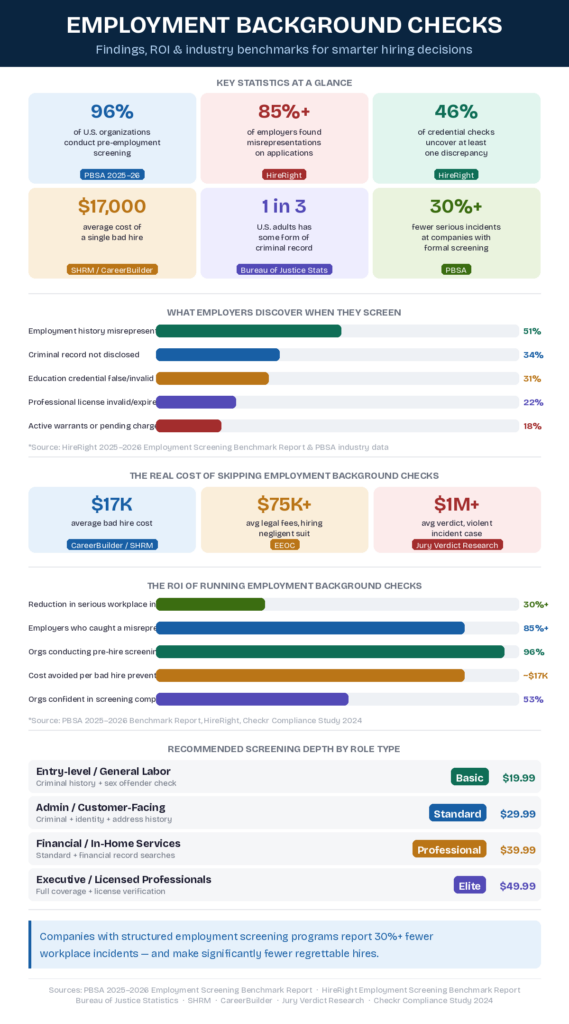
Basic ($19.99): Sex offender registry and statewide seven-year criminal history. Appropriate for entry-level roles with limited access to finances, data, or vulnerable populations.
Standard ($29.99): Adds SSN verification, Death Index check, nationwide criminal history, alias scans, and 20-year address history. The right baseline for most employer hiring decisions — covering the essential criminal, identity, and jurisdictional layers.
Professional ($39.99): Adds nationwide tax lien, civil judgment, and bankruptcy searches. Recommended for roles involving financial access, in-home service, or positions where candidates hold or handle client assets.
Elite ($49.99): The most comprehensive package — adds professional license verification, property ownership data, associate history, and more. The appropriate standard for executive hires, licensed professionals, and any role requiring the deepest available coverage.
For most small and mid-size business hiring, the Standard package covers the critical bases. For specific guidance on felony record searches specifically: Felony Background Check: What Employers Need to Know.
Step 2: Collect the Candidate’s Information
To run an accurate employment background check, you need:
- Full legal name — including any middle name or suffix
- Date of birth — critical for accurate record matching
- Social Security Number — collected via ClearCheck’s secure digital consent form
- Current and recent addresses — ensures jurisdictional coverage across every location the candidate has lived
The SSN and date of birth are what separate an accurate background check from one that surfaces records belonging to someone with a similar name — or misses records filed under a maiden name or alias. ClearCheck’s platform handles SSN trace and alias expansion automatically as part of the search.
Step 3: Send the FCRA Consent Request Digitally
ClearCheck’s built-in digital consent workflow handles the FCRA-required disclosure and written authorization in one seamless step. You enter the candidate’s basic information, the platform sends them a secure link, and they complete the process from any device — no printing, no scanning, no mailing, no follow-up calls.
Candidates typically complete the consent form in under three minutes. Your screening workflow keeps moving.
This step is non-negotiable. Running an employment background check without documented written consent is an FCRA violation regardless of intent — and ClearCheck makes it impossible to accidentally skip.
Step 4: Review Your Results
Most ClearCheck reports return in seconds to minutes. Your results appear in a secure, organized dashboard — categorized by check type for easy review.
When you receive the report, go through it systematically:
- Do the identity details exactly match the candidate you screened?
- Are there criminal records? If so, note the nature of the offense, the jurisdiction, and the date — all relevant to the individualized assessment the EEOC requires before taking adverse action
- Does the address history reflect what the candidate disclosed? Are there jurisdictions that warrant additional county-level searches?
- For employment or education verification: do the confirmed details match what the candidate listed on their application?
- For financial or professional roles: do any financial records or license discrepancies raise concerns?
Step 5: Make a Compliant Hiring Decision
If the report is clear — move forward with the hire.
If the report surfaces something that may affect your decision, you must follow the FCRA adverse action process before taking final action. ClearCheck provides pre-built templates and guided workflows for the pre-adverse action notice, report delivery, and final adverse action letter — all accessible directly from your dashboard. You are never navigating this alone.
For practical guidance on handling findings: Pre-Employment Screening Tips for Employers.

What the Law Requires at Every Stage of Employment Background Checks
Running employment background checks legally is not just about the FCRA. There are several layers of regulation every employer needs to understand — and a good screening service should be built to support all of them.
EEOC Individualized Assessment
Finding a criminal record on an employment background check does not give you automatic grounds for disqualification. EEOC guidelines require employers to conduct an individualized assessment considering:
- Nature and gravity of the offense — a DUI conviction is less relevant to a data analyst role than to a delivery driver position
- Time elapsed since the offense — a conviction from 12 years ago carries different weight than one from last year
- Nature of the job — the level of access, trust, and potential harm involved in the specific role
Blanket policies that automatically disqualify any candidate with any criminal record can constitute discriminatory hiring under federal law — particularly when those policies have a disparate impact on protected classes.
Ban the Box Laws
More than 35 states and 150+ municipalities have enacted Ban the Box legislation, which restricts when in the hiring process employers can inquire about criminal history. Most jurisdictions require employers to wait until after a conditional offer is extended before conducting a criminal background check.
ClearCheck’s platform is designed to support conditional-offer-stage screening workflows — so you are running checks at the legally compliant point in the process, not earlier.
State and Industry-Specific Requirements
Certain sectors have statutory background check requirements that go beyond the federal baseline. In healthcare, education, childcare, financial services, and transportation, compliance is not discretionary — it is legally mandated.
- North Carolina healthcare employers, for example, are subject to G.S. § 131E-256 requiring criminal checks for all staff with patient contact
- Federal FDIC regulations bar individuals with specific financial crime convictions from banking roles
- DOT-regulated transportation employers must follow federal screening and drug testing requirements for CDL drivers
The best employment background check services are built to support these industry and state-specific workflows. For more on state-specific requirements: Criminal Background Check NC: What Employers Need to Know.
The Most Common Mistakes Employers Make Running Employment Background Checks
Even well-intentioned employers make errors that create legal exposure or allow bad hires to slip through. Here are the most frequent — and how to avoid them.
Running only a national database search. National criminal databases are aggregations of self-reported state data — frequently incomplete and often lagging behind recent filings. A felony conviction from 18 months ago may not yet appear in the national database. Layering statewide and county-level searches closes this gap. ClearCheck’s Standard package and above include both national database and statewide searches by default.
Skipping consent documentation. The most common FCRA violation. It does not matter how clearly the hiring context implies consent — the FCRA requires a separate, standalone written disclosure and documented authorization before any check is run. ClearCheck’s digital consent workflow makes this impossible to accidentally skip.
Making automatic disqualification decisions. Any employment screening policy that automatically excludes all candidates with criminal records — without individualized assessment — creates EEOC exposure. Every finding requires evaluation in context of the role and the specific offense.
Not following the adverse action process. This is the most costly compliance mistake. Deciding not to hire someone because of their background check, without sending a pre-adverse action notice and allowing a dispute period, is a federal violation. ClearCheck provides the documentation and guided workflow to do this correctly every time.
Treating contractors and vendors differently than employees. Any individual who enters your facility, accesses your systems, or represents your brand carries risk — regardless of employment classification. Employment background checks should apply equally to full-time hires, part-time staff, contractors, and vendors.
For more on building a legally sound screening program: Background Screening Solutions for Employers.
Real Results: How a Healthcare Staffing Firm Transformed Their Hiring with ClearCheck
A healthcare staffing firm placing medical support staff across hospitals and outpatient clinics in the Southeast was operating with a fragmented screening process — some clients required checks, others did not, and the firm had no standardized protocol of its own.
After a single incident involving a placed worker whose undisclosed criminal record had not been screened, the firm overhauled their entire process and implemented ClearCheck’s Professional package across every placement.
The results over the following two quarters:
- Seven candidates with undisclosed criminal records identified before placement — three in roles that would have violated state healthcare screening statutes
- 100% FCRA compliance maintained across all placements since implementation
- Turnaround time reduced from 4–6 business days with their previous provider to under 10 minutes with ClearCheck
- Client contract renewals increased as hospital clients recognized the firm’s commitment to compliant, thorough pre-placement screening
- Legal exposure eliminated — zero screening-related compliance incidents in the 12 months post-implementation
“We didn’t have a process before — we had a patchwork,” their compliance manager noted. “ClearCheck gave us a real program we can stand behind.”
Data Report: Employment Background Checks by the Numbers

Employment Background Checks: Key Statistics (2026)
- 96% of U.S. organizations conduct at least one form of pre-employment screening (PBSA)
- 85%+ of employers have found misrepresentations on job applications (HireRight)
- 46% of employment and education verifications uncover a discrepancy (HireRight)
- $17,000 average cost of a single bad hire (CareerBuilder / SHRM)
- 47% of organizations lack confidence in their background check compliance (Checkr, 2024)
- 1 in 3 U.S. adults has some form of criminal record (Bureau of Justice Statistics)
- 30%+ reduction in serious workplace incidents at companies with formal screening programs
A study by MIT’s Sloan School of Management examining hiring practices found that employers using structured, consistent background screening protocols made significantly fewer regrettable hires than those relying on informal vetting — with the greatest impact in roles with financial access, client-facing responsibilities, or supervisory authority.
How Employment Background Checks Work Across Different Hiring Scenarios
Not every hire is the same. Here is how the screening process applies across the most common employment contexts.
Hiring Full-Time Employees
The most common scenario. Employment background checks for permanent staff should include at minimum a criminal history search, identity verification, and — for most positions — employment and education verification. For roles with elevated trust requirements, financial records and professional license verification should be added.
Onboarding Seasonal and Part-Time Workers
High-volume, time-sensitive hiring. The key is speed — a screening process that takes days will slow you down during peak hiring periods. For teams processing multiple candidates at once, ClearCheck’s bulk background checks make seasonal onboarding at scale faster and easier. ClearCheck’s Basic and Standard packages return results in minutes, making them ideal for seasonal onboarding at scale.
Screening Executive and Senior Leadership Hires
The stakes are highest at the top. Executive hires warrant the deepest available screening — ClearCheck’s Elite package adds property ownership records, associate history, and extended background data that standard packages do not cover.
Vetting Contractors, Vendors, and Subcontractors
Background checks should follow function, not classification. Anyone who enters your facility, interacts with your customers, or handles your data should be screened at the appropriate level for the access they have.
Rescreening Current Employees
An often-overlooked practice — particularly for roles with access to finances, sensitive systems, or vulnerable populations. Periodic rescreening of current staff is increasingly standard in healthcare, financial services, and logistics. ClearCheck supports ongoing screening with no additional setup required.

Frequently Asked Questions: How to Run Employment Background Checks
1. How long does an employment background check take with ClearCheck?
Most checks return results in 10 to 30 seconds. Some county-level criminal searches may take slightly longer depending on local data availability. The vast majority of ClearCheck reports complete in under five minutes.
2. Does every employee need the same level of screening?
No — and they should not. The appropriate screening depth depends on the role’s access level, trust requirements, and any applicable industry or state-specific statutory requirements. ClearCheck’s tiered packages make it straightforward to match the right check to the right position.
3. Can I run employment background checks on contractors and vendors, not just employees?
Yes. ClearCheck supports screening for any individual connected to your business, regardless of employment classification — including contractors, subcontractors, vendors, gig workers, and volunteers.
4. What if the background check comes back with a criminal record?
Do not take adverse action without completing the FCRA two-step adverse action process. ClearCheck provides pre-built templates and guided workflows for this process in your dashboard. You are never navigating a compliance decision without support.
5. How much does it cost to run employment background checks?
ClearCheck’s packages start at $19.99 per check with no subscription, no minimums, and no setup fees. For full pricing detail: How Much Does a Background Check Cost?
The Bottom Line: Running Employment Background Checks the Right Way
Here is what it comes down to.
Employment background checks are not just due diligence. They are your first line of defense against bad hires, legal exposure, and the kind of workplace incidents that change everything — for your team, your clients, and your business.
Knowing how to run employment background checks correctly means three things: understanding what to screen for, following the legal process every time, and using a platform fast enough to keep your hiring moving.
ClearCheck delivers all three — starting at $19.99, with results in minutes, and a platform built from the ground up around FCRA compliance.
Every great team was built one verified hire at a time. Start building yours.
Run Your First Employment Background Check Now — clearcheck.app
The next bad hire is preventable. ClearCheck delivers fast, FCRA-compliant employment background checks starting at $19.99 — results in minutes, no contracts, no setup fees.
Verify before you hire. Every time.