She was the perfect candidate. Two rounds of interviews, glowing references, a skill set that matched the job description line by line. The hiring manager at a mid-sized logistics firm in Charlotte sent the conditional offer on a Friday afternoon and kicked off the background check that same day.
Monday passed. Then Tuesday. Then Wednesday.
By Thursday, the candidate emailed: “I’ve received another offer. I need to give them an answer by end of day.”
The background check was still in progress — delayed by a county court that required manual record retrieval and a former employer that hadn’t responded to the verification request. The hiring manager scrambled to get an update, but by Friday morning, the candidate had accepted the other job.
This scenario plays out thousands of times every month across the country. And it raises the question every HR professional, landlord, and hiring manager eventually asks:
How long does a background check take?
The short answer: most standard employment background checks complete in one to three business days. But the real answer is more nuanced — because the timeline depends on the type of check, the number of jurisdictions searched, the responsiveness of third parties, and the screening provider you choose.
Let’s break down exactly what determines the timeline, where delays happen, and how to get results as fast as possible without sacrificing accuracy or compliance.
How Long Does a Background Check Take? The Quick Overview
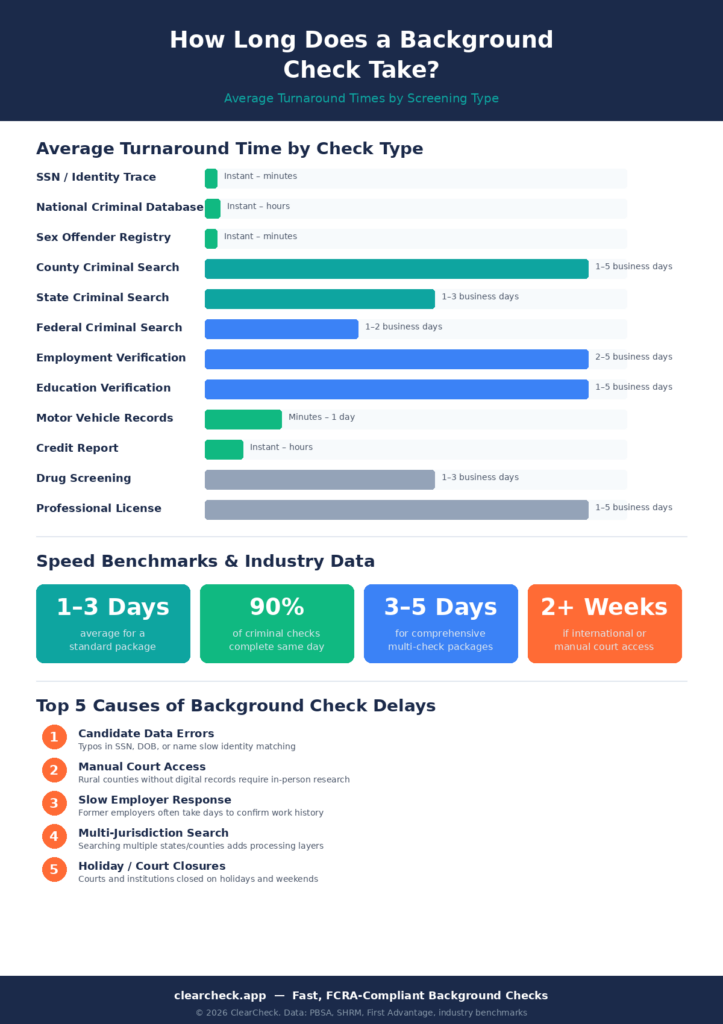
A standard employment background check — typically including an SSN trace, national criminal database search, and county criminal search — averages one to three business days from the moment the candidate submits their information.
But “standard” is doing a lot of heavy lifting in that sentence.
Comprehensive packages that include employment verification, education verification, credit reports, drug screening, and professional license checks can extend the timeline to three to five business days or longer. International checks or searches in jurisdictions with limited digital access can push turnaround to two weeks or more.
Here’s the general framework:
Instant to minutes: SSN/identity traces, national criminal database searches, sex offender registry checks, motor vehicle records, credit reports. These pull from digital databases and return almost immediately.
One to three business days: County criminal searches, state criminal searches, federal criminal searches, drug screening results. These require querying specific court systems and labs, some of which still operate on manual processes.
Two to five business days: Employment verification, education verification, professional license verification. These depend on third-party response times — former employers, schools, and licensing boards all operate on their own schedules.
One to two weeks or more: International background checks, searches in rural counties without digital records, or cases requiring in-person courthouse research.
The key insight: the total timeline of your background check is determined by the slowest component in the package, not the fastest. If nine out of ten searches return in hours but the tenth requires five days, your full report takes five days.
For a companion piece on what each of these checks actually reveals, see ClearCheck’s guide on what a background check shows.
How Long Does a Background Check Take by Type?
Let’s zoom into each component and set realistic expectations for turnaround.
Identity Verification and SSN Trace
Timeline: Instant — typically under 90 seconds.
This is always the first step. The SSN trace validates the candidate’s Social Security Number, surfaces aliases and former names, and generates an address history that guides all subsequent searches. Because it queries digital databases, results are virtually instantaneous.
If the SSN, name, and date of birth don’t match, the screening provider may need to contact the candidate for clarification — which can add hours or a day depending on how quickly the candidate responds.
Criminal Record Searches
National criminal database: Instant to a few hours. These searches scan aggregated databases containing millions of records across all 50 states. They’re fast, but they’re a starting point — not a substitute for direct court searches.
County criminal search: One to five business days. This is where most delays occur. County courts vary wildly in how they provide access to records. Many urban counties offer digital access, returning results within hours. But rural counties — and some major metro courts — still require a physical visit by a court researcher. When a record is found, additional verification at the court may add another day or two.
State criminal search: One to three business days. State-level searches query centralized repositories maintained by state law enforcement agencies. Most are digitized, but processing times vary by state.
Federal criminal search: One to two business days. Federal searches cover the 94 U.S. federal judicial districts and typically return quickly, since federal court records are well-digitized.
Understanding these layers is critical. A “criminal background check” isn’t one search — it’s often four or five searches running simultaneously across different court systems. The fastest component returns in minutes; the slowest can take nearly a week. ClearCheck’s detailed guide on criminal background checks in North Carolina illustrates how state-specific factors affect timing.
Employment Verification
Timeline: Two to five business days.
Employment verification is consistently the slowest component in a standard screening package — not because of the screening provider, but because it depends entirely on third-party response times.
Here’s what happens: the screening provider contacts each former employer listed on the candidate’s resume to confirm job title, dates of employment, and (where available) salary and reason for departure. If the former employer responds promptly, verification completes in a day or two. If the HR department is slow, unresponsive, or no longer exists, the process stalls.
Some employers use automated verification services like The Work Number, which can return results quickly. Others require manual phone calls and emails. And if the candidate worked for a subcontractor or staffing agency — common in logistics, construction, and gig-economy roles — identifying the correct verifying entity can add another day.
Pro tip for candidates: Notify your former employers and references that a verification request is coming. A quick heads-up can shave days off the process.
Education Verification
Timeline: One to five business days.
Education checks typically start by querying the National Student Clearinghouse, which compiles records from thousands of institutions. When the school participates and the data is current, results come back in minutes.
When the Clearinghouse doesn’t have the record — or when the request involves international institutions, older schools, or high school verification — the screening provider must contact the institution directly. During summer breaks, holidays, or exam periods, school registrar offices can be particularly slow to respond.
Research from the Georgetown University Center on Education and the Workforce has documented that credential misrepresentation remains a persistent issue across industries, which is why education checks — even when they slow down the timeline — remain essential.
Credit Reports
Timeline: Instant to a few hours.
Credit checks pull data from the three major credit bureaus (Equifax, Experian, TransUnion) and return quickly since the data is fully digitized. Credit reports are most commonly requested for roles involving financial responsibility — banking, accounting, and executive positions.
Motor Vehicle Records (MVR)
Timeline: Minutes to one business day.
Most states maintain digital databases of driving records, so MVR checks are among the fastest components. A few states require mail-based requests, which can extend the timeline to several business days — but this is increasingly rare.
Drug Screening
Timeline: One to three business days.
The clock starts when the candidate provides the specimen. Lab processing typically takes one to two business days for negative results. If the initial screen triggers a confirmation test (for a presumptive positive), add another day or two. Medical Review Officer (MRO) review adds additional time if the candidate needs to provide prescription documentation.
Professional License Verification
Timeline: One to five business days.
Verification timelines vary significantly by licensing board. Some boards offer instant online lookup; others require written requests and may take several business days to respond.

What Causes Background Check Delays?
Even with the best screening provider, certain factors can extend the timeline. Here are the most common culprits — and what you can do about each one.
Candidate Data Errors
A transposed digit in a Social Security Number. A misspelled former employer name. A missing middle name that creates ambiguity in court records. Small errors create big delays because the screening provider must pause and verify before proceeding.
Fix: Provide candidates with a clear data collection form and stress the importance of accuracy. A pre-screening email that explains what information they’ll need — and why precision matters — reduces errors significantly.
Manual Court Access
Not every courthouse operates in the digital age. In some rural counties, criminal records can only be accessed by a court clerk or an in-person researcher. Court backlogs, limited staffing, and restricted hours can add days to what would otherwise be an instant search.
Fix: Work with a screening provider that maintains a network of court researchers and can estimate turnaround by jurisdiction before the search begins. ClearCheck provides estimated delivery windows so you always know what to expect.
Slow Third-Party Responses
Employment verification is the most frequent bottleneck, but education institutions, licensing boards, and even credit bureaus can be slow during peak periods. Some former employers have policies that limit them to confirming only dates of employment — nothing more — which still requires processing time on their end.
Fix: Ask candidates to give their former employers and references advance notice. A short heads-up can cut response time dramatically.
Multi-Jurisdiction Searches
Candidates who have lived and worked across multiple states require searches in each jurisdiction. Each additional county or state adds a processing layer — and if any of those jurisdictions has manual-only access, the entire package waits.
Fix: Use an SSN trace to identify the most relevant jurisdictions upfront, and structure the search package to prioritize high-risk addresses first.
Holiday and Court Closures
Courts, schools, and government offices close on weekends, federal holidays, and state-specific observances. A background check initiated on a Friday before a holiday weekend may not resume processing until the following Tuesday or Wednesday.
Fix: Plan your screening timeline around known closures. If timing is critical, initiate checks early in the week.
How to Speed Up Your Background Checks
You can’t control every variable, but you can eliminate the most common sources of preventable delay. Here’s how.
Choose the right screening provider. The single biggest factor in turnaround time is the technology and network your provider uses. Providers with automated court access, digital verification integrations, and real-time status tracking consistently deliver faster results than those relying on manual processes. Leading providers report that 89–90% of criminal searches complete within the same day.
Collect candidate information upfront. Don’t wait until after the conditional offer to collect the candidate’s SSN, date of birth, and consent. Having this information ready means the screening provider can begin immediately.
Right-size your screening package. Not every role requires every check. A warehouse associate may need criminal and identity verification. A senior finance director may need criminal, credit, education, and employment verification. Ordering only what’s relevant to the role eliminates unnecessary processing time.
Communicate with candidates. Let candidates know what to expect — what information they’ll need to provide, approximately how long the process takes, and what to do if a former employer contacts them for verification. Informed candidates are faster candidates.
Stagger results. Many screening providers, including ClearCheck, deliver results as they complete — not all at once. This means you can begin reviewing criminal and identity results within hours while employment verification continues in the background.
For more detailed cost-versus-speed considerations, see how much does a background check cost.

ClearCheck Success Story: From Five-Day Turnaround to Under 48 Hours
A regional healthcare staffing agency in Houston was losing candidates to competitors during the screening phase. Their previous provider averaged four to five business days for a standard criminal-plus-verification package — and during holiday weeks, turnaround stretched past seven days.
After switching to ClearCheck, the agency restructured their screening workflow: SSN trace and national criminal database results began returning within hours of candidate consent. County criminal searches completed within 24 hours for most Texas jurisdictions. Employment verification — historically the bottleneck — improved because ClearCheck’s automated outreach system sent verification requests immediately instead of queuing them for manual follow-up.
The result: average turnaround dropped from five business days to under 48 hours for their standard package. In the six months since the switch, the agency estimates they’ve avoided losing at least 40 candidates who would have accepted competing offers during the old waiting period.
At an average placement fee of $3,500, those 40 saved placements represent $140,000 in recovered revenue — from a screening process that costs less than $30 per candidate.
What to Do If Your Background Check Is Taking Too Long
If you’re a candidate waiting on results, here’s what to know:
Some delay is normal. One to three business days is standard. If you submitted your information on a Friday, don’t expect results until Tuesday or Wednesday.
Check your information. Verify that you provided your correct SSN, date of birth, full legal name, and accurate address history. A mismatch on any of these can stall the process.
Respond promptly to requests. If the screening provider or your prospective employer asks for additional information or clarification, respond as quickly as possible. Every hour of delay on your end adds to the total timeline.
Give former employers a heads-up. A quick email or text to your previous supervisors letting them know a verification call is coming can shave days off the process.
Ask for a status update. It’s entirely reasonable to ask your prospective employer or their screening provider for a progress update after three business days. Good providers offer real-time tracking so candidates can check status without making a phone call.
If you want to proactively see what your report will show before an employer runs one, ClearCheck lets you run a background check on yourself — same speed, same compliance, full transparency.

The Bottom Line: Speed and Accuracy Don’t Have to Be Trade-Offs
How long does a background check take? With the right provider, one to three business days for a standard package. With the wrong one — or with no provider at all — weeks of delay, lost candidates, and exposure to negligent hiring risk.
The fastest background check in the world is worthless if it’s inaccurate. And the most thorough check is useless if it takes so long that the candidate accepts another offer before results arrive.
ClearCheck delivers both: speed that keeps your hiring pipeline moving and compliance that keeps your organization protected. Results begin arriving within hours. Most standard packages complete in under 48 hours. And you never pay for checks you didn’t need.
Stop Losing Candidates to Slow Screening — Switch to ClearCheck
Every day a background check is pending, your best candidate gets closer to saying yes to someone else. ClearCheck delivers FCRA-compliant results in hours — not weeks. Starting at $19.99, no contracts, no setup fees.
The clock is already ticking on your next hire. Don’t let a slow screening process cost you the person you’ve already chosen.